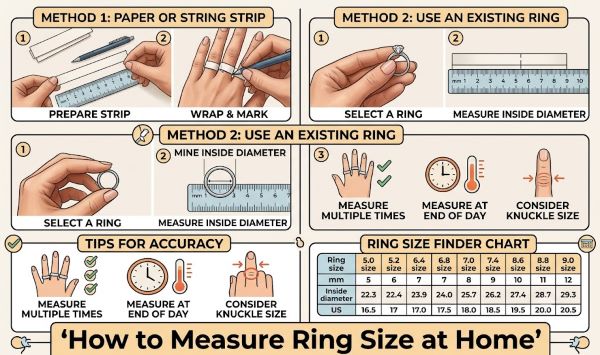
Buying a ring for someone else is stressful enough without the added uncertainty of sizing. And even when you’re buying for yourself, it’s easy to guess wrong. Ring sizing charts exist, but they only help if you know what you’re measuring in the first place. The good news is that you can measure ring size at home accurately enough to buy with confidence using a few basic household items.
This guide covers three reliable methods to measure ring size at home, explains what can throw off your measurement, and tells you what to do if your result falls between sizes.
What You Need to Know Before You Start
Ring size is measured in the circumference or diameter of the finger, then converted to a standardized number. In the US, ring sizes run from about 3 to 13 for adults, with half sizes available. The most common women’s size is around 6 to 7, and the most common men’s size is around 9 to 10, but these are just averages. Finger size varies significantly based on hand dominance, temperature, and time of day.
A few important rules before measuring:
- Measure at the end of the day when fingers are slightly larger due to normal swelling.
- Avoid measuring when you are cold. Cold fingers can be half a size smaller than normal.
- The knuckle on some fingers is wider than the base. Measure both and size up to ensure the ring passes over the knuckle comfortably.
- Dominant hands are typically slightly larger than non-dominant hands. Measure the specific finger you plan to wear the ring on.
Method 1: String or Paper Strip
This is the most common way to measure ring size at home and it works well when done carefully.
What you need: A thin strip of paper or a piece of string, a pen, and a ruler.
Steps:
- Cut a strip of paper about half an inch wide and six inches long, or use a piece of string.
- Wrap it snugly around the base of the finger you want to measure. Snug means it sits against the skin without pinching. If you can’t slide it at all, it’s too tight.
- Mark the point where the paper or string overlaps itself with a pen.
- Lay the strip flat and measure from the end to the mark with a ruler. This gives you the circumference of your finger in millimeters.
- Use a ring size conversion chart to match the millimeter measurement to a US ring size.
Quick reference:
| Circumference (mm) | US Ring Size |
|---|---|
| 47 mm | 4 |
| 49 mm | 4.5 |
| 51 mm | 5 |
| 52 mm | 5.5 |
| 54 mm | 6 |
| 56 mm | 6.5 |
| 57 mm | 7 |
| 59 mm | 7.5 |
| 60 mm | 8 |
| 62 mm | 8.5 |
| 64 mm | 9 |
| 65 mm | 9.5 |
| 67 mm | 10 |
Method 2: Existing Ring
If you have a ring that already fits the target finger well, measuring it is faster and often more accurate than wrapping a finger.
What you need: The existing ring and a ruler.
Steps:
- Place the ring on a flat surface.
- Measure the inside diameter of the ring from one inner edge to the opposite inner edge. Do not include the metal itself, only the open space inside.
- Record the measurement in millimeters.
- Use a diameter-to-size chart to find the matching ring size.
Quick reference:
| Inner Diameter (mm) | US Ring Size |
|---|---|
| 15.3 mm | 4.5 |
| 15.7 mm | 5 |
| 16.1 mm | 5.5 |
| 16.5 mm | 6 |
| 16.9 mm | 6.5 |
| 17.3 mm | 7 |
| 17.7 mm | 7.5 |
| 18.1 mm | 8 |
| 18.9 mm | 9 |
| 19.8 mm | 10 |
This is the most reliable way to measure ring size at home when you have access to a well-fitting ring.
Method 3: Printable Ring Sizer
Many jewelers offer a free printable ring sizer on their website. You print the page at 100% scale (no scaling, no fit-to-page), cut out the sizing circles, and place your existing ring over them to match the diameter.
Before trusting this method, verify the scale. Print the page and measure a known reference object in the printout. If a one-inch reference box on the printout measures one inch on your ruler, the scale is correct. If it doesn’t match, your printer is rescaling the document and the results will be off.
Common Mistakes That Lead to Wrong Measurements
Knowing how to measure ring size at home correctly means avoiding these common errors. A ring should slide on with light resistance and come off with moderate effort. If your measurement requires more force than that, size up by half.
Measuring at the wrong time of day. Fingers swell in heat and shrink in cold. Measuring first thing in the morning or after time outdoors in winter gives a smaller reading than your actual wearing size.
Not accounting for the knuckle. On some people, especially older adults, the knuckle is noticeably wider than the finger base. In this case, measure the knuckle circumference too. The ring needs to pass over it to reach the base, so size to the knuckle and accept that the ring will sit slightly loose at the base.
Using a flimsy strip that stretches. Regular paper works well. Fabric or elastic string stretches under tension and gives a smaller reading than the actual circumference. Use non-stretch string or paper.
What to Do If You’re Between Sizes
When your measurement puts you between a whole and a half size, always round up, not down. A ring that is slightly too large can be resized or worn with a ring guard adjuster. A ring that is too small cannot be worn at all.
Most jewelers offer one free resize for rings purchased from them, so confirm this before buying and mention that you measured at home if you’re uncertain about the size.
Key Takeaways
- You can measure ring size at home with a paper strip, an existing ring, or a printable sizer. No professional tools are required.
- The string or paper method measures circumference in millimeters, which you then convert using a standard size chart.
- Measuring an existing ring by its inner diameter is faster and often more accurate if you have a ring that already fits well.
- Measure at the end of the day when fingers are at their natural size, not in the morning or when cold.
- If the knuckle is wider than the finger base, measure the knuckle and size to that measurement.
- When your result falls between sizes, size up. A slightly large ring is fixable. A small ring is not wearable.
- If you’re buying a surprise gift and can’t measure directly, borrow a ring from the person’s jewelry box and measure the inner diameter instead of guessing.
- Confirm your printer is printing at 100% scale before trusting a printable ring sizer. Rescaled printouts produce wrong measurements.