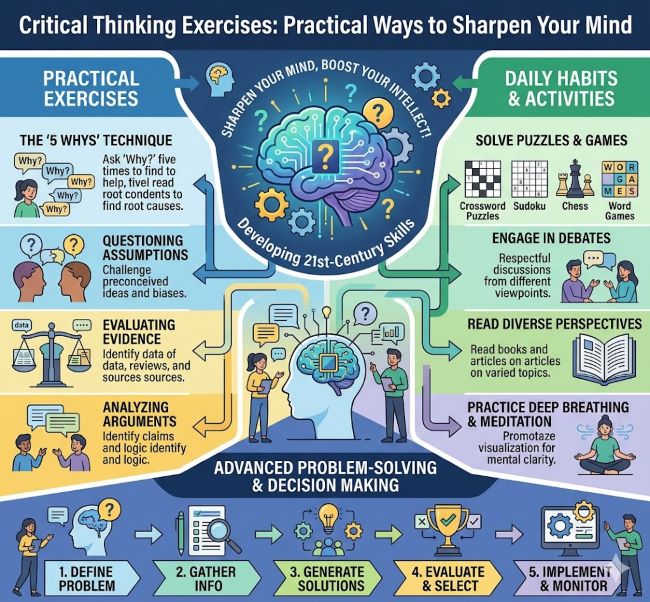
Most people go through life accepting information without examining it closely. They hear a claim and assume it’s true. They face a problem and default to the first solution that comes to mind. This is the opposite of critical thinking. Learning critical thinking exercises trains your brain to question, analyze, and evaluate information with precision.
The good news: critical thinking is not a trait you’re born with. It’s a skill you develop through practice. This guide walks you through specific critical thinking exercises you can start using immediately, along with critical thinking examples that show how these techniques work in real situations.
What Critical Thinking Actually Is
Before diving into critical thinking exercises, let’s be clear about what critical thinking means. It’s not about being critical or negative. Critical thinking is the ability to analyze information objectively, identify underlying assumptions, recognize bias, and form reasoned conclusions.
When you practice critical thinking exercises, you’re training yourself to:
- Question assumptions instead of accepting them at face value
- Identify logical fallacies when you encounter them
- Separate fact from opinion
- Recognize bias in sources and reasoning
- Evaluate evidence quality before drawing conclusions
- Consider alternative viewpoints
- Make decisions based on reasoning, not emotion
Most critical thinking examples in daily life involve situations where people skip these steps. Someone reads a headline and shares it without reading the article. Another person trusts advice from a friend without considering whether the friend has relevant expertise. These represent thinking that skips critical analysis.
Critical thinking exercises reverse this pattern. They force you to slow down and examine information carefully before accepting it.
Why Critical Thinking Exercises Matter
The world rewards people who think critically. In your career, the ability to solve problems systematically and evaluate decisions carefully makes you more valuable than someone who reacts emotionally or accepts information uncritically.
In your personal life, critical thinking exercises help you avoid scams, make better financial decisions, and navigate relationships with more clarity. You spend less time influenced by manipulative advertising or misinformation because you’ve trained yourself to evaluate claims.
Learning how to improve critical thinking also makes you a better communicator. You listen more carefully, ask better questions, and understand nuance instead of defaulting to extremes.
Critical Thinking Exercises You Can Start Today
Exercise 1: The Five Whys
When faced with a problem or claim, ask “why” five times. This forces you to dig past surface explanations to underlying causes.
Example: Your project missed its deadline.
Why? The team ran out of time. Why? We didn’t start early enough. Why? We didn’t understand the project scope clearly. Why? The initial brief was vague. Why? We didn’t ask clarifying questions during the kickoff.
Real cause identified: Unclear communication at the start. This exercise works across situations: missed goals, relationship conflicts, business problems. It reveals root causes instead of letting you stay at the surface level.
Exercise 2: Assumption Identification
Every argument rests on assumptions. Read or listen to a claim, then write down what it assumes to be true.
Example: “You should buy this supplement because it’s made from natural ingredients.”
Underlying assumptions:
- Natural = safe (arsenic is natural)
- Expensive = effective
- One person’s success = everyone’s success
- Testimonials are honest
Once you identify assumptions, you can evaluate whether they’re reasonable. Many claims slip through because people accept assumptions without thinking.
Exercise 3: Evaluate Sources
Before accepting information, ask: Who said this? What’s their background? What do they stand to gain?
Critical thinking exercises involving source evaluation reveal bias immediately.
Example: A weight loss company publishes research saying their product works. As a source for weight loss advice, this has obvious bias. They profit if you believe their claim. This doesn’t mean the research is wrong, but it means you should find independent verification before trusting it.
Better sources: Peer-reviewed studies, researchers with no financial stake, multiple independent sources confirming the same finding, expert consensus.
This critical thinking example applies to everything from medical advice to political claims to financial recommendations. Always ask who’s speaking and what they gain from your belief.
Exercise 4: Identify Logical Fallacies
A logical fallacy is reasoning that looks convincing but is actually flawed. Spotting fallacies trains you to recognize weak arguments.
Common fallacies:
Ad Hominem: Attacking the person instead of the argument. “You’re wrong because you’re stupid.”
Appeal to Authority: Assuming something is true because an authority said it. “Celebrities use this, so it must work.”
False Dichotomy: Presenting only two options when more exist. “Either you work 80 hours or you’re lazy.”
Hasty Generalization: Drawing conclusions from limited examples. “My friend got sick at a restaurant, so it has bad food.”
Slippery Slope: Claiming one thing leads inevitably to another without evidence. “If we allow this, everything will collapse.”
Spotting these fallacies sharpens your own reasoning.
Exercise 5: Play Devil’s Advocate
Take a position you agree with, then argue against it as strongly as possible. Critical thinking exercises like this force you to understand opposition viewpoints and test your own beliefs.
Example: You believe remote work is better for productivity.
Arguments against:
- Team collaboration happens more naturally in person
- Younger employees need mentoring that’s harder remotely
- Communication delays can slow decision-making
- Some people struggle with isolation
By arguing against your own position, you’re forced to:
- Understand legitimate concerns
- Identify where your position might be incomplete
- Refine your thinking with nuance instead of conviction
This is how you improve critical thinking from absolute certainty to nuanced understanding.
Exercise 6: Analyze Data and Statistics
Statistics are used constantly, often misleadingly. Critical thinking exercises involving data analysis teach you to question numbers.
Ask:
- What’s the sample size? (Small samples are unreliable)
- Who collected the data? (Bias affects who gets measured)
- What time period? (Short-term trends don’t show long-term patterns)
- Are they showing absolute numbers or percentages? (A 100% increase from 1 person to 2 looks dramatic but isn’t meaningful)
- What’s being compared? (Comparing different things can seem to show relationships that don’t exist)
Example: “Studies show chocolate is healthy.” This might be true for dark chocolate in small amounts, but the claim is vague. What studies? Dark or milk chocolate? How much? Over what period?
Learning how to improve critical thinking around data means asking these questions before accepting statistical claims.
Exercise 7: Generate Multiple Solutions
When facing a problem, critical thinking exercises teach you to generate at least three solutions before picking one. The first solution that comes to mind is rarely the best.
Problem: You’re spending too much money each month.
Quick solution: Earn more money.
Better solutions after critical thinking:
- Track where money actually goes (awareness reveals waste)
- Negotiate bills (phone, insurance, subscriptions)
- Change habits (coffee, meals out, impulse purchases)
- Prioritize spending on what matters most
- Set a realistic budget based on actual spending
The more solutions you generate, the better your eventual choice becomes.
Exercise 8: Ask Better Questions
Questions shape what you learn. Critical thinking exercises involving questions teach you to ask more deeply.
Instead of: “Does this work?” (yes/no, not useful) Ask: “In what situations does this work? What conditions must be present? What are the limitations? Who benefits from this? What would disprove it?”
Better questions open up thinking. They force you to consider nuance instead of accepting simple answers.
Critical Thinking Examples in Real Life
Professional Example
You’re in a meeting and a colleague proposes a solution to a recurring problem. Using critical thinking exercises you’ve practiced:
You don’t immediately agree or disagree. Instead, you ask: What’s the root cause we’re solving? Have we tried this before? What assumptions is this based on? What could go wrong?
This doesn’t mean being contrarian. It means thinking before responding. Often, you’ll find the proposed solution is solid but incomplete, or it solves the symptom rather than the cause.
Personal Example
You read a news story about a health topic and immediately think of sharing it. But you pause and apply critical thinking exercises:
Who published this? What’s their track record? Is this their original reporting or copying from elsewhere? What evidence supports the claim? Are there credible sources saying something different?
Only after these questions do you decide whether to share it.
Financial Example
A friend recommends an investment. Instead of assuming they know what they’re talking about, you apply critical thinking:
What’s their investment background? How do they know this is good? What’s their return been? What fees are involved? What could go wrong? Am I comfortable with the risk they’re comfortable with?
These questions prevent following bad advice from well-meaning people.
Best Ways to Enhance Critical Thinking
Read Widely
Exposure to different viewpoints, writing styles, and disciplines strengthens critical thinking. Read books outside your field. Read sources that disagree with you. Read primary sources instead of summaries.
Discuss and Debate
Talking through ideas with people who think differently forces you to articulate and defend your reasoning. Debate (civil discussion, not argument) is one of the best ways to enhance critical thinking because you must explain why you believe what you believe.
Reflect on Your Mistakes
When you’re wrong, investigate why. This is one of the best ways to enhance critical thinking: treating mistakes as learning opportunities. What assumption was faulty? What evidence did you miss? What biases influenced your thinking?
Practice Regularly
Critical thinking exercises work through repetition. Doing one exercise once teaches you nothing. Questioning assumptions daily, evaluating sources regularly, and spotting fallacies constantly strengthens the skill.
Slow Down
Quick reactions bypass critical thinking. When you’re about to make a decision, share information, or form an opinion, pause. Ask yourself the critical thinking questions. This one habit is transformative.
Seek Diverse Perspectives
Surround yourself with people who think differently. Read authors with different backgrounds and beliefs. Travel. These expose you to viewpoints that challenge yours and prevent echo chambers where critical thinking atrophies.
Study Logic and Reasoning
Taking a class or reading a book on logic, rhetoric, or reasoning teaches you the formal structures of good thinking. You learn why certain arguments work and others don’t.
Critical Thinking vs. Cynicism
An important distinction: critical thinking is not cynicism. Cynicism assumes everything is motivated by self-interest. Critical thinking assumes claims should be tested.
Someone with critical thinking might hear a claim and think: “This might be true. Let me see the evidence.”
A cynic hears the same claim and thinks: “This is obviously false because people are selfish.”
Both involve questioning, but cynicism skips evaluation. It concludes without evidence.
Best ways to enhance critical thinking include learning to balance skepticism with openness. Question claims, but stay willing to be convinced by good evidence. This is harder than either naive acceptance or blanket cynicism, but it’s the real skill.
Making Critical Thinking Automatic
The exercises described here feel slow at first. Asking five whys, identifying assumptions, and evaluating sources take time. That’s fine. As you practice, critical thinking becomes faster.
Eventually, you’ll spot logical fallacies while listening to conversation. You’ll automatically evaluate source credibility when reading. You’ll ask clarifying questions instead of making assumptions.
This happens through repetition. The brain is trainable. Every time you practice a critical thinking exercise, you strengthen those neural pathways.
Key Takeaways
- Critical thinking exercises train your brain to question, analyze, and evaluate information instead of accepting it uncritically.
- The Five Whys exercise reveals root causes by asking “why” repeatedly until you find the true source of a problem.
- Critical thinking examples show up daily: evaluating news claims, making career decisions, choosing financial advisors, and assessing health information.
- How to improve critical thinking starts with identifying assumptions underlying claims and arguments you encounter.
- Source evaluation reveals bias by asking who is speaking and what they gain from your belief.
- Spotting logical fallacies like ad hominem and false dichotomy is a core skill strengthened through practice.
- Playing devil’s advocate against your own beliefs forces you to understand opposing viewpoints.
- Analyzing data and statistics teaches you to question sample size, data collection methods, and what’s being compared.
- Best ways to enhance critical thinking include reading widely, discussing with different perspectives, and reflecting on mistakes.
- Generating multiple solutions before choosing one yields better decisions than the first idea.
- Asking better questions shapes what you learn; specific questions open up thinking.
- Critical thinking is not cynicism; it’s remaining open to evidence while questioning claims.
- Slowing down before making decisions gives you space to apply thinking skills.
- Regular practice makes critical thinking automatic and faster with experience.