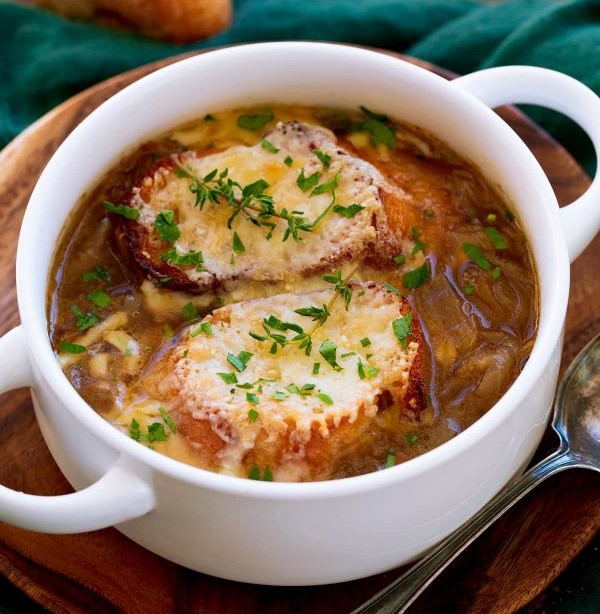
French onion soup is one of the most abused dishes on restaurant menus. It appears everywhere from airport bistros to neighborhood French restaurants, and most versions are not worth ordering. The problem is that the dish is defined entirely by patience. The onions must caramelize slowly over at least 45 minutes, often longer, developing their natural sugars into a deep, complex sweetness that no shortcut produces. The broth must be rich and deeply flavored from good beef stock. The cheese must be properly gratineed under a broiler until it is brown, bubbly, and slightly charred at the edges.
A bowl made from fast-cooked pale onions in thin stock with barely melted cheese is not french onion soup in any meaningful sense. Finding french onion soup near me means knowing which restaurants have the discipline to make it properly.
What Makes French Onion Soup Good
The dish has three components and each requires specific attention.
The onions. Yellow or white onions, sliced thin and cooked slowly in butter over low to medium heat for 45 to 60 minutes or longer. During this time they lose most of their moisture, their sugars concentrate and caramelize, and they transform from sharp and pungent to sweet, jammy, and deeply flavored. The finished onions should be a deep golden to dark amber color and should be soft enough to be almost translucent. The most common shortcut is cooking them on high heat for 15 minutes, which produces lightly browned but not truly caramelized onions that taste flat and slightly sharp. A bowl of french onion soup with pale, barely softened onions was made in a hurry.
The broth. A properly made french onion soup uses a rich beef broth or stock, sometimes enriched with white wine or dry sherry during the caramelization process, that has enough body from the gelatin in the bones to feel substantial in the mouth. Commercial beef broth from a carton produces a flat, thin result that no amount of seasoning fully corrects. Some restaurants use a combination of beef and chicken stock, which produces a slightly lighter but still acceptable broth. The broth should be deeply savory and should taste of the caramelized onions that have been simmering in it.
The gratin. A slice of baguette or crusty bread placed on top of the soup in the bowl, covered with grated Gruyere or Emmental cheese, and placed under a broiler until the cheese is brown, bubbly, and slightly crusty at the edges. The cheese layer should extend to the edges of the bowl, sealing in the steam from the soup below. When you break through the cheese crust with a spoon, it should offer resistance before giving way. Barely melted cheese that has not been properly gratineed was either not placed close enough to the broiler or not left under heat long enough.
When you search for french onion soup near me, asking whether the onions are properly caramelized and whether the broth is made in-house are the two most useful questions before ordering.
Where to Find It
French bistros and brasseries are the most reliable source. A restaurant that specifically identifies its cooking as French will treat french onion soup as a foundational dish rather than a novelty. French bistros in cities with established French restaurant communities tend to make the soup correctly because it is a test of basic technique that the kitchen cannot afford to fail.
Traditional American steakhouses sometimes carry french onion soup as a starter and treat it with the same respect given to their prime steaks. A steakhouse that makes its own stocks and takes its starter program seriously will produce a good version.
Classic American diners and supper clubs in the Midwest and Northeast with French onion soup as a longstanding menu item often develop consistent, practiced approaches to the dish. A restaurant that has been making the same soup recipe for decades will have refined it past most newer operations.
French-influenced hotel restaurants in major cities sometimes produce excellent french onion soup because they have the equipment and the kitchen discipline to make stock and caramelize onions properly for high-volume service.
How to Search More Effectively
A search for french onion soup near me will return hundreds of results ranging from fast casual chains to dedicated French restaurants. Here is how to find the ones making it properly:
Search Google Maps for French bistro, French restaurant, or brasserie in your city and look at menu descriptions. A menu that describes the soup as made with caramelized onions, house-made broth, or gratineed Gruyere is making specific claims about preparation quality that are worth investigating.
Search Yelp for french onion soup specifically and read reviews that describe both the onion color and the broth depth. Reviewers who order this dish regularly will describe whether the onions were a deep amber color and properly sweet, whether the broth had real depth, and whether the cheese was properly gratineed. These three details predict quality better than a star rating.
Search Instagram with “french onion soup” plus your city name. French restaurants and bistros that produce a beautiful gratineed bowl post photos regularly, and the deep amber of the onions visible through the soup crocks, the golden-brown cheese crust with charred edges, and the steam rising from a properly hot bowl are all identifiable in a good photo.
Ask any restaurant whether the onions are caramelized for at least 45 minutes and whether the broth is made in-house. A kitchen doing both from scratch will answer with confidence. A kitchen using commercial stock and fast-cooked onions will either confirm the shortcuts or give vague answers.
What Good French Onion Soup Should Look Like
Once you find a source and the bowl arrives, a few things confirm the quality.
The cheese crust. Brown and slightly charred at the edges, bubbly in the center, and extending to the rim of the bowl. Breaking through the cheese with a spoon should require a moment of resistance before it gives way. A pale, flat cheese layer that yields immediately was not properly gratineed under a hot broiler.
The onion color visible through the broth. Where onions are visible through the cheese or at the edges of the bowl, they should be a deep golden to amber color, not pale yellow or lightly browned. Dark amber onions cooked properly will be almost translucent.
The broth color. Deep amber to rich brown, slightly thick from the dissolved gelatin if bone stock was used. A pale, clear broth lacks the depth that comes from properly caramelized onions simmered in a rich beef stock.
The temperature. Served extremely hot, almost uncomfortably so, from the broiler. French onion soup should arrive at the table still bubbling around the edges. A lukewarm bowl was either not made to order or was allowed to cool between the broiler and the table.
The bread layer. A slice or two of crusty bread beneath the cheese, softened from the hot soup but still providing some structure when the cheese is first broken. The bread should not have completely dissolved into the broth.
Ordering and Eating Tips
Order french onion soup as a starter rather than alongside a main course. The richness of the melted cheese and the caramelized onion sweetness work best when you are not simultaneously eating other rich foods.
Break through the cheese from the center rather than the edges. The center of the cheese crust is softest and most bubbly, and breaking from the center allows you to mix the cheese into the soup gradually as you eat rather than having it all slide to one side.
Eat it hot and immediately. French onion soup cools quickly once the cheese crust is broken, and the experience of the bubbling, gratineed cheese against the rich sweet broth diminishes within minutes of the crust being disturbed.
Pair with a glass of dry white wine or a light red. A white Burgundy or a simple Beaujolais both work well against the sweetness of the caramelized onions and the richness of the Gruyere.
Pricing Expectations
French onion soup at a French bistro or traditional restaurant typically runs between $12 and $22 as a starter depending on the market and the restaurant. Steakhouse versions tend to be priced in the $14 to $20 range. Classic diner versions run lower, between $8 and $14. Very cheap versions at non-specialized restaurants are worth approaching with caution as proper caramelization and house-made broth have real time and cost implications that very low prices do not cover.
Key Takeaways
- Finding quality french onion soup near me is most reliable at French bistros, traditional steakhouses, and long-established American restaurants that have been making the same recipe for decades.
- The onions must be properly caramelized for at least 45 to 60 minutes. Deep amber color and a jammy, sweet flavor confirm proper caramelization. Pale or lightly browned onions indicate a rushed preparation.
- In-house beef broth from bones produces the gelatin body and depth that commercial carton stock cannot replicate. Ask directly whether the broth is made in-house.
- The cheese crust should be brown and slightly charred at the edges, requiring a moment of resistance before the spoon breaks through. Pale, easily yielding cheese was not properly gratineed.
- Eat it hot and immediately after the cheese crust is broken. The experience declines quickly as the soup cools.
- Ask any restaurant whether the onions are caramelized for at least 45 minutes and whether the broth is house-made. Confident specific answers confirm proper preparation.
- Pair with dry white wine or light red to complement the sweet onion and rich cheese without competing with either.
- Expect to pay $12 to $22 at a French bistro or steakhouse for a properly made version.