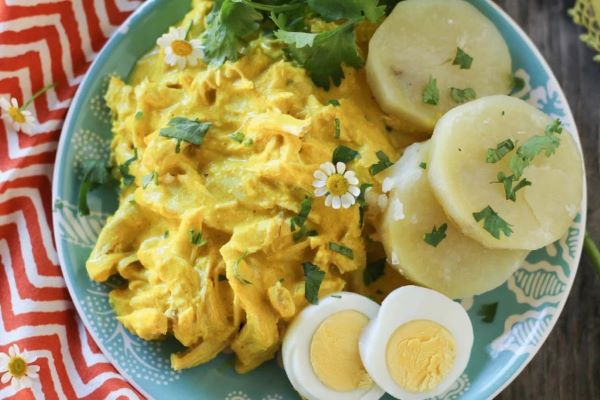
Aji de gallina is one of the great dishes of Peruvian cooking and one of the clearest expressions of what makes Peruvian cuisine distinct. Shredded poached chicken in a sauce built from aji amarillo, bread, evaporated milk, walnuts, and Parmesan, producing a thick, golden, creamy preparation that is simultaneously rich and bright, spiced and gentle, and unlike anything else in South American cooking. When a kitchen gets it right, the layered complexity of the sauce is remarkable for a dish that uses straightforward ingredients.
When they get it wrong, the sauce is either too bland because the aji amarillo was insufficient, or too harsh because the other sauce elements were not balanced against the chili’s heat. Finding the best aji de gallina near me means knowing what the properly made version tastes like and which restaurants are taking the trouble to build the sauce correctly.
What Aji de Gallina Actually Is
The name translates as hen’s chili, and the dish historically used hen, which is an older, more flavorful bird than a standard chicken, slow-cooked to develop a rich broth before being shredded. Modern versions use regular chicken, typically poached breast or thigh, which is less flavorful but more tender and more available.
The sauce is the defining element and the part that requires the most skill. It starts with aji amarillo, the fruity, moderately hot orange-yellow Peruvian chili that appears throughout Peruvian cooking. The aji amarillo can be fresh, roasted, or as paste, and it is blended into the sauce base along with onion and garlic that have been cooked in oil until soft. Bread, typically stale white bread or rolls soaked in evaporated milk, is added to the blended mixture and provides the thickness and slightly creamy character of the sauce. Walnuts, ground into the sauce, add richness and a slight bitterness that balances the chili. Parmesan cheese, which arrived in Peruvian cooking through Italian immigration in the 19th century, adds a savory depth and a slight sharpness that runs through the sauce.
The shredded chicken is mixed into the finished sauce and everything is served over white rice with boiled potato and a slice of hard-boiled egg on top. The yellow olives called aceituna botija, if available, are the traditional garnish that adds a briny note alongside the rich sauce.
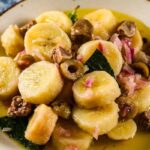
The color of properly made aji de gallina is a vivid golden yellow from the aji amarillo, and this color is one of the most immediate quality indicators when the plate arrives.
When you search for the best aji de gallina near me, the vivid yellow color from the aji amarillo, the complexity of the sauce from the bread, walnuts, and Parmesan, and the balance between the chili heat and the creamy richness are the markers of a kitchen making it properly.
Where to Find It
Peruvian restaurants are the only reliable source. Aji de gallina is a dish so specifically Peruvian in its ingredients and technique that it appears almost exclusively on Peruvian restaurant menus and in Peruvian home cooking. A restaurant with a comprehensive traditional Peruvian menu will carry aji de gallina as a main course alongside lomo saltado, ceviche, and papa a la huancaina.
Peruvian cevicherias and lunch restaurants sometimes carry aji de gallina as a rotating daily special or as a permanent menu offering. These casual Peruvian restaurants tend to have a more complete traditional menu than restaurants focused primarily on ceviche, and aji de gallina appears regularly in their daily rotation.
Peruvian home cooks and community vendors selling through Instagram and Facebook are a strong source in cities where dedicated Peruvian restaurants are scarce. Home cooks who grew up eating aji de gallina will make it with the aji amarillo and walnuts and Parmesan that define the dish, producing a version that is often more carefully made than restaurant production at volume.
Latin American restaurants with a Peruvian chef or Peruvian ownership sometimes carry aji de gallina even if the broader menu does not focus on Peruvian cuisine. A restaurant that includes several specifically Peruvian dishes on its menu is likely to make aji de gallina properly.
How to Search More Effectively
A search for the best aji de gallina near me will surface Peruvian restaurants in your area. Here is how to identify the ones making it with proper technique:
Search Google Maps for Peruvian restaurant in your city and browse menu descriptions for aji de gallina. A menu that describes the sauce components, including aji amarillo, bread, walnuts, and Parmesan, indicates a kitchen thinking about the dish in its complete traditional form rather than as a generic label.
Search Yelp for Peruvian restaurants and read reviews that mention aji de gallina. Reviewers who know the dish will describe whether the sauce was the correct vivid yellow color, whether it was properly thick from the bread and walnuts, and whether the aji amarillo provided adequate heat without overwhelming the other sauce elements. These details distinguish a kitchen following the traditional recipe from one making a simplified version.
Search Instagram with “aji de gallina” plus your city name. Peruvian restaurant accounts and home cook vendors post photos of aji de gallina regularly, and the vivid golden yellow color of a properly made sauce with shredded white chicken visible throughout is one of the most distinctive and visually beautiful presentations in Peruvian cooking.
Ask any Peruvian restaurant directly what goes into their aji de gallina sauce. A kitchen making the traditional version will describe the aji amarillo, the bread soaked in evaporated milk, the walnuts, and the Parmesan without hesitation. A kitchen making a simplified version will describe a more abbreviated sauce.
What Good Aji de Gallina Should Look Like
Once you find a source and the plate arrives, a few things immediately confirm the quality.
The sauce color. Vivid golden yellow from the aji amarillo, uniform throughout the sauce rather than streaky or pale in some areas. The aji amarillo should be fully integrated into the sauce base, producing a consistent, saturated color. A pale yellow or white sauce means insufficient aji amarillo was used.
The sauce consistency. Thick enough to coat the shredded chicken and to pile slightly on the plate rather than spreading immediately. The bread and walnut components should give the sauce a body that is clearly thicker than a cream sauce or a simple broth. A thin, watery sauce was not properly made with the bread and walnut components.
The chicken. Shredded into thin, tender strands, evenly distributed through the sauce. The chicken should taste of the poaching broth it was cooked in, with a clean, mild flavor that allows the aji de gallina sauce to be the star of the plate. Overcooked, dry chicken pulls into stringy fibers rather than clean strands.
The heat. A gentle warmth from the aji amarillo that builds slightly as you eat, not a sharp immediate heat. Aji amarillo is moderately hot but its heat is fruity and lingering rather than sharp. A version without any warmth was made with insufficient aji amarillo. A version that is aggressively hot used too much without the bread and walnut balance to temper it.
The complexity. The combined flavor of the aji amarillo, walnut, Parmesan, and evaporated milk creates a sauce with multiple distinct flavor layers rather than a single note. Each element should be perceptible as contributing something different: the chili provides heat and fruitiness, the walnut adds bitterness and richness, the Parmesan adds sharpness, and the evaporated milk adds sweetness and body.
Ordering and Eating Tips
Order aji de gallina as a main course with white rice and boiled potato as the traditional accompaniments. The potato absorbs the sauce in a satisfying way and the white rice provides a neutral backdrop that allows the complex sauce flavor to be the focus.
Ask whether the garnish includes aceituna botija, the Peruvian yellow olive. These olives are specific to Peruvian cooking and their briny richness against the creamy aji de gallina sauce is a combination that adds an important final note to the dish.
Eat the chicken, rice, potato, egg, and olive together in each bite whenever possible. The combination of all components is the intended experience, and the brininess of the olive against the creamy sauce and starchy potato is the kind of layered flavor that makes Peruvian cooking specifically interesting.
The dish holds and reheats well because the sauce thickens slightly as it cools and then loosens again when reheated. A home cook or vendor version from a previous day will have a slightly thicker sauce that is worth thinning with a small amount of water or stock when reheating.
Pricing Expectations
A full plate of the best aji de gallina near me at a Peruvian restaurant typically runs between $16 and $24 depending on the market and the restaurant. Casual Peruvian lunch restaurants tend to be at the lower end of that range. Home cook and vendor versions sold by the portion are typically in the $12 to $18 range.
Key Takeaways
- The best aji de gallina near me is most reliably found at Peruvian restaurants with traditional menus and at Peruvian home cook vendors who describe the sauce components specifically including aji amarillo, bread soaked in evaporated milk, walnuts, and Parmesan.
- Aji de gallina sauce is a complex preparation of aji amarillo blended with onion, garlic, bread soaked in evaporated milk, ground walnuts, and Parmesan, producing a thick, vivid golden sauce that is simultaneously creamy, spiced, and layered with distinct flavor contributions from each ingredient.
- The vivid golden yellow color and the thick consistency are the two most immediate quality markers. Pale or thin sauce indicates insufficient aji amarillo or missing sauce components.
- Ask directly what goes into the sauce. A kitchen using all traditional components will describe the aji amarillo, bread, walnuts, and Parmesan without hesitation.
- The heat from the aji amarillo should be gentle and fruity, building as you eat. A very mild version lacks sufficient aji. An aggressively hot version lost the balance from the walnut and bread.
- Eat with white rice, boiled potato, hard-boiled egg, and aceituna botija if available for the complete traditional Peruvian plate.
- Search Instagram with “aji de gallina” plus your city name. The vivid golden sauce is one of the most visually striking and immediately identifiable preparations in all of Peruvian cooking.
- Expect to pay $16 to $24 at a sit-down Peruvian restaurant and $12 to $18 per portion from a home cook or community vendor.