Zarzuela de mariscos is one of those Spanish dishes that sounds like it should be more famous than it is. A richly flavored seafood stew built on a base of sofrito and saffron, loaded with a variety of shellfish and fish, finished with a picada of ground almonds, fried bread, and garlic that thickens and deepens the sauce in a way that no other technique quite replicates. It is the kind of dish that requires a skilled hand and good seafood, which is perhaps why it does not travel as widely as paella or ceviche.
When it is made properly, zarzuela de mariscos is as complete and satisfying a seafood preparation as Spanish cooking produces. If you have been searching for the best zarzuela de mariscos near me, this guide gives you the framework to find a kitchen capable of making it correctly.
What Zarzuela de Mariscos Actually Is
The name zarzuela comes from a form of Spanish operetta, light and varied, and the dish follows the same logic: a variety of different seafood in a single preparation. Zarzuela is associated particularly with the Catalan and Mediterranean coast of Spain, where the diversity of available shellfish and fish makes a mixed seafood stew a natural expression of the local ingredients.
The preparation begins with a sofrito base cooked slowly until the tomato and onion have completely broken down and caramelized slightly, producing a sweet, concentrated foundation. Garlic, dried ñora pepper or pimenton, and sometimes white wine go into the sofrito. Saffron, bloomed in warm water before being added, gives the sauce its characteristic golden color and floral depth.
The seafood is added in stages based on cooking time. The most common components include clams and mussels, which open in the steam and release their briny liquid into the sauce; prawns or shrimp; calamari or cuttlefish rings; and firm-fleshed fish like monkfish, hake, or cod. Each type of seafood is added at a different point so that everything finishes cooking at approximately the same time.
The picada is what makes zarzuela de mariscos distinctive from other seafood stews. This Catalan technique involves grinding together fried bread, toasted almonds, garlic, and sometimes parsley into a fine paste, which is stirred into the stew in the final minutes of cooking. The picada thickens the sauce, adds nuttiness and body, and ties all the flavors together in a way that no flour-thickened sauce can achieve.
When you search for the best zarzuela de mariscos near me, the saffron color of the broth, the variety of the seafood, and the presence of a picada for thickening are the markers of a kitchen making the traditional Catalan preparation rather than a simplified version.
Where to Find It
Catalan and Spanish Mediterranean restaurants are the primary source. A restaurant that specifically identifies Catalan cooking, coastal Spanish cuisine, or Mediterranean Spanish food in its menu description is more likely to carry zarzuela de mariscos as a serious preparation than a general Spanish tapas bar.
Spanish seafood restaurants that prioritize fresh seafood sourcing and build their menu around marine ingredients are worth seeking out. A restaurant that lists the origin of its seafood or changes its menu based on seasonal availability treats the ingredients with enough respect to produce a well-executed zarzuela.
Spanish restaurants in coastal cities where fresh seafood is more readily available tend to produce better versions. Cities like Miami, New York, San Francisco, and Los Angeles have access to quality shellfish and fish that makes a multi-component seafood stew more practical and more flavorful than in landlocked markets.
Spanish cultural events and food festivals with Catalan representation sometimes feature zarzuela as a showcase dish. Events organized by Catalan cultural associations or Spanish cultural organizations that emphasize regional diversity are worth checking.
How to Search More Effectively
A direct search for the best zarzuela de mariscos near me will return Spanish restaurants in your area. Here is how to find the ones making it properly:
Search Google Maps for Spanish restaurant or Catalan restaurant in your city and browse menus for zarzuela. A menu description that lists the specific seafood components and mentions saffron or picada in the description indicates a kitchen following the traditional preparation with attention to technique.
Search Yelp for Spanish restaurants and read reviews that mention zarzuela de mariscos. Reviewers who know the dish will describe whether the broth was properly saffron-golden, whether the seafood was cooked correctly without toughening, and whether the sauce had the distinctive nutty depth from the picada. These details distinguish a proper preparation from a simplified version.
Search Instagram with “zarzuela mariscos” plus your city name. Spanish restaurant accounts that produce a proper zarzuela post photos, and the golden-orange broth with multiple visible shellfish and fish types is immediately distinctive in a photo.
Ask any Spanish restaurant whether they include picada in their zarzuela and what types of seafood they use. A kitchen making a proper zarzuela will describe the picada process and the variety of seafood specifically. A kitchen making a simplified version will describe a more straightforward preparation.
What Good Zarzuela de Mariscos Should Look Like
Once you find a source, a few things confirm the quality.
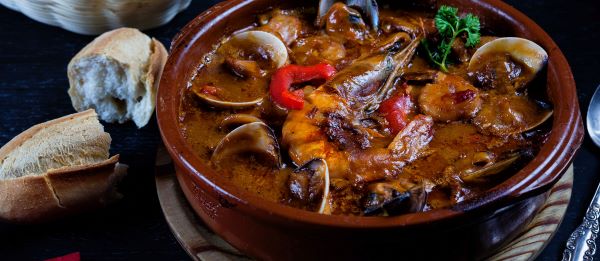
The broth color. Golden to deep orange from the saffron and the sofrito base, with visible fat droplets from the olive oil and the shellfish. The saffron should be clearly perceptible as a golden hue running through the entire sauce rather than appearing only in concentrated areas. A pale or brown broth without golden tones means insufficient saffron.
The seafood variety. Multiple types of shellfish and fish visible in the bowl: open clams and mussels with their liquid contributing to the sauce, intact prawns or shrimp, calamari rings, and pieces of fish. A zarzuela with only one or two types of seafood is not meeting the variety that defines the dish.
The seafood texture. Each type cooked correctly for its specific requirements. Clams and mussels should be open but not rubbery. Shrimp should be pink and just cooked through. Calamari rings should be tender, not chewy. Fish pieces should flake with gentle pressure. Overcooked seafood throughout the bowl indicates the different components were added simultaneously rather than sequentially.
The sauce body. Thicker than a plain broth, with some viscosity from the picada. The sauce should coat the seafood and the bread used for soaking rather than being thin and watery. Thin sauce indicates the picada was omitted or used in insufficient quantity.
The almond and bread note. Subtly present in the background flavor of the sauce, adding a nuttiness that distinguishes the Catalan preparation from other seafood stews. This is difficult to detect independently but is perceptible as a depth and richness in the sauce that is absent when the picada is not used.
Ordering and Eating Tips
Order zarzuela de mariscos as a main course for two to share if the restaurant serves it in a large format, or as an individual main course if it is portioned individually. It is a substantial dish that does not need much alongside it beyond bread for soaking the sauce.
Eat the shellfish while the broth is hot. Clams and mussels that have been sitting in hot liquid continue cooking, and eating them promptly preserves their best texture. The fish and calamari similarly deteriorate in texture if left in the hot sauce for too long.
Use plenty of bread for soaking. The picada-thickened saffron sauce is one of the best parts of zarzuela de mariscos and bread is the appropriate vehicle. A kitchen that does not automatically offer bread with this dish has not thought through the eating experience.
Pair with a crisp white wine from the Spanish Mediterranean coast. Albariño from Galicia, though not a Catalan wine, pairs well with shellfish stews. A Catalan Blanc from Penedes or Priorat produces a more regionally specific pairing if available.
Pricing Expectations
A serving of the best zarzuela de mariscos near me at a Spanish restaurant typically runs between $28 and $48 as a main course, reflecting the cost of multiple types of fresh shellfish and fish and the labor-intensive preparation. The price range is wide because the market for fresh seafood varies significantly by city and season. Restaurants in coastal markets with better seafood access may price it lower while using superior ingredients.
Key Takeaways
- The best zarzuela de mariscos near me is most reliably found at Catalan or Spanish Mediterranean restaurants that specifically reference coastal Spanish cuisine and demonstrate commitment to fresh seafood sourcing.
- Zarzuela de mariscos is a Spanish seafood stew built on a saffron-sofrito base, loaded with multiple types of shellfish and fish, and finished with a picada of ground almonds and fried bread that thickens and deepens the sauce.
- The saffron golden color and the variety of at least three to four types of seafood in the bowl are the most immediate quality markers. A pale broth or limited seafood variety indicates a simplified preparation.
- The picada is what distinguishes the Catalan preparation from other seafood stews. Ask whether the restaurant includes picada in their zarzuela. A specific answer confirms proper technique.
- Each seafood type should be cooked correctly: open clams and mussels, pink just-cooked shrimp, tender calamari, and flaking fish. Uniform toughness indicates all seafood was added simultaneously.
- Use bread generously for soaking the picada-thickened saffron sauce. The sauce is among the best parts of the dish.
- Pair with Albariño or a Catalan white wine for a complement to the saffron and shellfish flavors.
- Expect to pay $28 to $48 at a Spanish restaurant, reflecting the cost of quality seafood and the labor-intensive preparation.