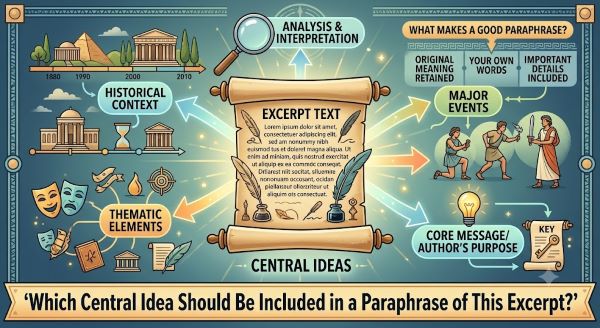
Paraphrasing is one of the most tested skills in academic English and reading comprehension courses, and the question “which central idea should be included in a paraphrase of this excerpt” appears frequently in standardized tests, language arts assignments, and reading worksheets. Answering it correctly requires understanding what a central idea is, how it differs from supporting details, and what a paraphrase must include to be accurate.
This guide explains those distinctions clearly and gives you a practical method for identifying the central idea in any excerpt.
What Is a Central Idea?
A central idea is the main point that an author makes in a piece of writing. It is what the text is fundamentally about, expressed in a way that reflects the author’s argument or position rather than just the topic.
The topic of a passage might be “climate change.” The central idea is more specific: “Human activity is the primary driver of recent climate change.” The topic names what the text discusses. The central idea states what the text says about that topic.
A central idea is:
- Broad enough to cover the whole passage, not just one section
- Specific enough to reflect the author’s actual claim or message
- Supported by the majority of the details in the text
A central idea is not:
- A single detail or example from the passage
- A question the passage raises without answering
- A personal opinion you form after reading
What Is a Paraphrase?
A paraphrase restates the content of a passage in your own words while keeping the original meaning intact. It is different from a summary in scope: a summary condenses the main points, while a paraphrase often restates the content at roughly the same length, just in different language.
An effective paraphrase:
- Uses different words and sentence structures from the original
- Preserves the meaning and tone of the original
- Includes the central idea of the passage
- Does not add interpretations or opinions that weren’t in the original text
Which Central Idea Should Be Included in a Paraphrase of This Excerpt?
When this question appears on an exam or assignment with a specific excerpt provided, the method for answering it is the same regardless of what the passage is about.
Step 1: Read the entire excerpt before deciding on the central idea.
It’s tempting to pick the first sentence as the central idea because many writers state their main point at the beginning. But some passages build toward the central idea, state it midway, or imply it through cumulative examples. Read everything before committing.
Step 2: Ask what the majority of the passage is about.
If most of the sentences in the excerpt relate to one particular claim or argument, that claim is likely the central idea. Details, examples, and statistics in the passage should support the central idea, not compete with it.
Step 3: Distinguish the central idea from supporting details.
Supporting details are specific facts, statistics, anecdotes, or examples that back up the central idea. They are important to include in a full paraphrase, but they are not the central idea themselves. The question of which central idea should be included in a paraphrase of this excerpt is specifically asking for the main overarching claim, not a detail.
Step 4: Test each answer choice against the passage.
In a multiple-choice format, each option will either be the central idea, a supporting detail, a topic without a claim, or something not found in the passage at all. The correct answer should be broad enough to cover the whole excerpt, specific enough to reflect the author’s actual point, and supported by the majority of the passage’s content.
Step 5: Check that the central idea captures the author’s position.
The best paraphrases reflect not just what the author discussed but what the author argued or concluded. If the passage is argumentative, the central idea includes the author’s stance. If it is informational, the central idea captures the main takeaway.
Common Wrong Answers on This Type of Question
When asked which central idea should be included in a paraphrase of this excerpt, students most commonly choose:
A detail rather than the main idea. A specific statistic or example may be mentioned in the passage, but if the whole passage is not about that specific detail, it is not the central idea. Be careful with answer choices that are accurate but too narrow.
The topic instead of the central idea. “The passage is about the American Revolution” describes the topic. The central idea would be something like “The American Revolution was driven more by economic grievances than political philosophy.” If the answer choice is just a topic label without a claim, it is too vague to be the central idea.
Something not in the passage. Occasionally an answer choice sounds plausible but introduces information the passage never mentions. If you cannot point to specific sentences in the excerpt that support the answer, it is not the correct central idea.
An overgeneralization. The central idea should fit the passage specifically. An answer that is so broad it could apply to any text on that general subject is usually not the right choice.
How to Write a Paraphrase That Captures the Central Idea
Once you have identified the central idea of the excerpt, building a paraphrase around it follows a clear structure:
- State the central idea in your own words at or near the beginning.
- Restate the key supporting points using different vocabulary and sentence structure.
- Maintain the logical flow of the original passage.
- Avoid copying phrases directly from the original. Change both the words and the structure, not just one or the other.
Key Takeaways
- Which central idea should be included in a paraphrase of this excerpt is asking you to identify the main overarching claim of the passage, not a detail, a topic label, or an outside opinion.
- A central idea covers the whole passage, reflects the author’s actual argument or takeaway, and is supported by the majority of the text.
- Read the entire excerpt before identifying the central idea. Some passages state it at the end or imply it through accumulated evidence rather than stating it directly in the first sentence.
- Supporting details (statistics, examples, anecdotes) are not the central idea even when they are important to the passage.
- In multiple-choice format, eliminate answers that are too narrow (a single detail), too broad (just the topic), not found in the passage, or so general they could apply to any text on that subject.
- Which central idea should be included in a paraphrase of this excerpt is answered by finding the claim the majority of the passage supports, then restating it in your own words.
- An effective paraphrase changes both the vocabulary and the sentence structure of the original while preserving its meaning and logical flow.
- When in doubt, ask: if someone who had not read the passage read only this central idea statement, would they understand the author’s main point? If yes, you have the right idea.