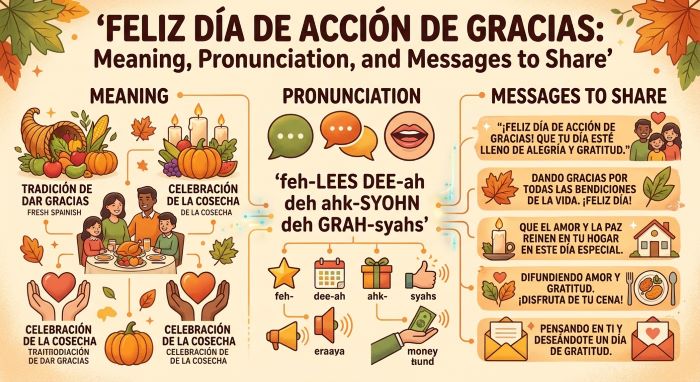
Picture a long table on the last Thursday of November. There’s turkey, rice and beans, maybe a tray of pasteles, and three generations talking over each other in two languages. Someone raises a glass and says, “Feliz dia de accion de gracias!” Everyone cheers.
That phrase means “Happy Thanksgiving Day” in Spanish. If you want to greet Spanish-speaking friends, family, or coworkers this season, this guide covers what it means, how to say it, how it’s written, and plenty of messages you can send. Thanksgiving 2026 falls on Thursday, November 26, so you have time to get it right.
What Does Feliz Dia de Accion de Gracias Mean?
Let’s break the phrase down word by word:
- Feliz means “happy.”
- Día means “day.”
- de means “of.”
- Acción means “action” or “act.”
- de Gracias means “of thanks.”
Put together, feliz dia de accion de gracias reads as “Happy Day of the Act of Giving Thanks.” In plain English, it’s just “Happy Thanksgiving.”
Many people shorten it in casual speech. “¡Feliz Acción de Gracias!” works fine and sounds natural. In some homes, you’ll also hear “¡Feliz Día de Gracias!” which drops the word “Acción.”
How to Write It Correctly
In formal Spanish, the phrase carries accent marks and an opening exclamation point:
¡Feliz Día de Acción de Gracias!
Here’s what matters:
- The accent on Día marks the stress on the “í.”
- The accent on Acción puts the stress on the final syllable.
- Spanish uses an upside-down exclamation mark (¡) at the start of an exclamation.
That said, most people type feliz dia de accion de gracias without accents in texts and social posts. Phone keyboards make accents a little annoying, and readers will understand you either way. For a printed card or a formal email, use the accents. For a quick text, don’t stress about it.
How to Pronounce It
If you don’t speak Spanish, the phrase can look like a mouthful. It’s easier than it seems. Try it in chunks:
| Spanish | Sounds Like |
|---|---|
| Feliz | feh-LEES |
| Día | DEE-ah |
| de | deh |
| Acción | ahk-see-OHN |
| de | deh |
| Gracias | GRAH-see-ahs |
Say it slowly first: feh-LEES DEE-ah deh ahk-see-OHN deh GRAH-see-ahs. Then speed up. In Spain, you’ll hear “Gracias” pronounced closer to “GRAH-thee-ahs,” but the Latin American version above is the one most people in the US use.
Who Celebrates Thanksgiving in Spanish?
Thanksgiving is mostly a US holiday, but Spanish speakers mark it in several places.
Latino families in the United States. Millions of Hispanic households celebrate Thanksgiving, often mixing classic dishes with family recipes. Turkey might share the table with tamales, arroz con gandules, or flan.
Puerto Rico. As a US territory, Puerto Rico celebrates Thanksgiving on the same day as the mainland. Many families serve “pavochón,” a turkey seasoned like roast pork (lechón).
Canada. Canada celebrates its own Thanksgiving on the second Monday of October. Spanish-speaking Canadians use the same greeting.
Expats and mixed families. In Mexico and other parts of Latin America, the holiday isn’t official. Still, American expats and families with ties to the US often host dinners, and the greeting travels with them.
Feliz Dia de Accion de Gracias Messages for Family
Family messages can be warm and personal. Here are a few you can copy or tweak:
- “¡Feliz Día de Acción de Gracias, familia! Gracias por estar siempre a mi lado.” Happy Thanksgiving, family! Thank you for always being by my side.
- “Doy gracias a Dios por tenerlos en mi vida. Los quiero mucho.” I thank God for having you in my life. I love you all very much.
- “Que esta mesa siempre esté llena de amor, risas y comida rica.” May this table always be full of love, laughter, and good food.
- “Mamá, gracias por todo lo que haces. ¡Feliz Día de Acción de Gracias!” Mom, thank you for everything you do. Happy Thanksgiving!
Messages for Friends
Friends get a lighter touch. A little humor goes a long way:
- “¡Feliz Acción de Gracias, amigo! Que comas pavo hasta no poder más.” Happy Thanksgiving, friend! May you eat turkey until you can’t anymore.
- “Agradezco tener amigos como tú. ¡Disfruta el día!” I’m grateful to have friends like you. Enjoy the day!
- “Hoy doy gracias por las risas, los consejos y las aventuras que compartimos.” Today I give thanks for the laughs, advice, and adventures we share.
Messages for Coworkers and Clients
At work, keep it short and polite. A clean feliz dia de accion de gracias greeting works well in an email sign-off or a team chat:
- “Le deseo un feliz Día de Acción de Gracias a usted y a su familia.” I wish you and your family a happy Thanksgiving. (formal)
- “Gracias por su confianza este año. ¡Feliz Día de Acción de Gracias!” Thank you for your trust this year. Happy Thanksgiving! (for clients)
- “Equipo, gracias por su esfuerzo. ¡Disfruten el fin de semana largo!” Team, thank you for your hard work. Enjoy the long weekend!
Notice the use of usted in formal messages. It’s the respectful form of “you,” and it fits clients, bosses, and people you don’t know well.
Short Greetings for Texts and Social Media
Sometimes you only need a few words. These fit a text, a story, or a caption:
- ¡Feliz Día de Acción de Gracias! 🦃
- Agradecido por todo. (Grateful for everything.)
- Mucho que agradecer. (So much to be thankful for.)
- Hoy y siempre, gracias. (Today and always, thank you.)
- Familia, comida y gratitud. (Family, food, and gratitude.)
Hashtags like #AcciónDeGracias and #FelizDíaDeAcciónDeGracias help your post reach Spanish-speaking audiences.
Useful Thanksgiving Words in Spanish
Want to add more to your greeting or chat at dinner? Here are words you’ll hear around the table:
| English | Spanish |
|---|---|
| Turkey | Pavo |
| Stuffing | Relleno |
| Mashed potatoes | Puré de papas |
| Cranberry sauce | Salsa de arándanos |
| Pumpkin pie | Pastel de calabaza |
| Gravy | Salsa de carne |
| Gratitude | Gratitud |
| To give thanks | Dar gracias |
| Family dinner | Cena familiar |
Try asking “¿Me pasas el pavo, por favor?” (Can you pass the turkey, please?) and you’ll earn a few smiles.
Tips for Using the Greeting Naturally
A few small habits make your Spanish sound more natural:
- Match the setting. Use the full feliz dia de accion de gracias for cards and formal notes. Use “¡Feliz Acción de Gracias!” with friends.
- Add a personal line. A greeting alone is nice. A greeting plus one sentence of thanks feels warmer.
- Don’t worry about mistakes. Native speakers appreciate the effort. A missing accent won’t offend anyone.
- Respond in kind. If someone greets you first, a simple “¡Igualmente!” (Same to you!) works.
Wrapping Up
Saying feliz dia de accion de gracias is a small gesture with a big effect. It shows care for the people you’re greeting and respect for the language they grew up with. Whether you’re texting your abuela, signing a client email, or toasting at a bilingual dinner, you now have the words, the pronunciation, and the messages to make it count.
Key Takeaways
- “Feliz dia de accion de gracias” means “Happy Thanksgiving Day” in Spanish. The short form “¡Feliz Acción de Gracias!” is common in casual speech.
- The formal spelling is ¡Feliz Día de Acción de Gracias! with accents on Día and Acción and an opening upside-down exclamation mark. Accents are often skipped in texts.
- Pronounce it as feh-LEES DEE-ah deh ahk-see-OHN deh GRAH-see-ahs.
- Thanksgiving 2026 falls on Thursday, November 26 in the US. Canada celebrates on the second Monday of October.
- Latino families in the US and households in Puerto Rico celebrate the holiday, often mixing turkey with dishes like tamales, arroz con gandules, or pavochón.
- Use usted for formal messages to clients and bosses, and add one personal line to make any greeting feel warmer.
- Reply to a Thanksgiving greeting with “¡Igualmente!” to wish the same in return.