Most people who know ropa vieja know the Cuban version, which has become one of the most recognized dishes in Latin American cooking. Far fewer people know that the dish originated in the Canary Islands, the Spanish archipelago off the coast of northwest Africa, and that the Canarian version is a fundamentally different preparation. The Cuban version uses shredded beef braised in a tomato and pepper sauce. The ropa vieja canaria uses chickpeas, potatoes, and leftover meat from a previous broth, dressed simply with olive oil, garlic, and sometimes cumin and paprika. It is a dish of leftovers elevated by technique rather than a slow braise built from scratch.
If you have been searching for the best ropa vieja canaria near me and ending up with results for Cuban-style shredded beef, this guide explains the distinction clearly and gives you a realistic path to finding the Canarian original.
What Ropa Vieja Canaria Actually Is
The name means old clothes in Spanish, referring to the shredded, irregular appearance of the ingredients rather than any literal clothing connection. In the Canary Islands, ropa vieja is traditionally made from the leftover meat and chickpeas that were cooked in a puchero, which is the Canarian version of the Spanish cocido, a long-simmered stew of meat, legumes, and vegetables.
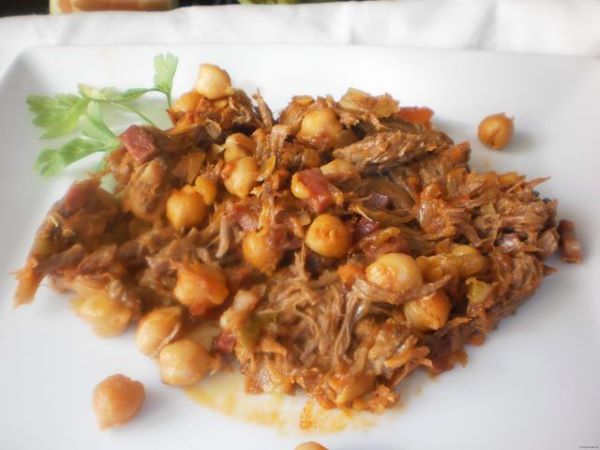
The next day, those leftovers are shredded or roughly broken apart and fried in olive oil with garlic, and often with sliced potato that has also been cooked in the original broth. The result is a pan of crispy-edged chickpeas, tender shredded meat, and slightly crisped potato, all brought together in the garlic-infused olive oil. Some versions add cumin and sweet paprika. Some add a splash of white wine to the pan during the frying step. The texture is varied: soft chickpeas, slightly crisped edges on the potato, irregular strands of tender meat.
Ropa vieja canaria is honest food. It does not pretend to be more than it is, which is a resourceful and satisfying use of ingredients that had already been cooked once. The fact that those ingredients were cooked slowly in a rich broth makes the second preparation, the frying in olive oil with garlic, more flavorful than a dish built from scratch.
When you search for the best ropa vieja canaria near me, you are looking for this specific Canarian preparation rather than the Cuban shredded beef dish that shares the name.
Where to Find It
Canarian restaurants are the primary source, and they are genuinely rare outside of Spain and the Canarian expat communities in cities like London, Berlin, and parts of South America. In the United States, dedicated Canarian restaurants are extremely uncommon. Most Spanish restaurants outside of specialty establishments do not distinguish between mainland Spanish and Canarian cuisine.
Spanish restaurants with regional menus that specifically reference Canarian or island cooking are worth investigating. A restaurant that mentions mojo sauce, papas arrugadas, or other Canarian specialties on its menu is operating with enough knowledge of the cuisine to potentially carry ropa vieja canaria.
Canarian cultural associations in cities with Spanish immigrant communities sometimes organize community meals and cultural events where traditional Canarian food is prepared by home cooks. These events are worth seeking out for a version of ropa vieja canaria that is more likely to be authentic than anything from a restaurant not specifically focused on Canarian cooking.
Spanish home cooks from the Canary Islands are your most reliable source in cities without dedicated Canarian restaurants. Social media groups for Spanish expats, particularly those from the Canary Islands, Las Palmas de Gran Canaria communities, or Tenerife communities in your city, are worth joining and asking directly.
Making it at home is a realistic option once you understand the dish. If you can make a chickpea stew or purchase prepared chickpeas, the second-day frying step is straightforward. The dish is approachable enough that a home cook who understands the basic technique can produce a faithful version with good ingredients.
How to Search More Effectively
Given how rare dedicated Canarian restaurants are outside of Spain, a direct search for the best ropa vieja canaria near me will likely return limited useful results. Here is a more productive approach:
Search for Spanish restaurants in your city that specifically mention Canarian food, mojo rojo, papas arrugadas, or Canary Islands on their menus or social media. These are the strongest indicators that the kitchen has knowledge of and interest in Canarian cooking.
Search Facebook for Canarian communities or groups in your city, specifically people from Gran Canaria, Tenerife, Lanzarote, or the broader Canary Islands. These communities maintain food connections and will know whether anyone locally makes or sells traditional Canarian food.
Search Instagram with “ropa vieja canaria” broadly to understand what the dish looks like in photos, then add your city name to see whether any local posts exist. The visual difference from Cuban ropa vieja is clear in photos: chickpeas, potato, and irregular meat rather than saucy shredded beef.
Contact Spanish cultural organizations in your city and specifically ask whether anyone represents the Canarian community or organizes Canarian food events. Some cities have active Canarian associations that are not easily findable through standard searches.
What Good Ropa Vieja Canaria Should Look Like
If you find a source, a few things confirm whether the preparation is authentic.
The chickpeas. Tender from their original slow cooking, with slightly crisped edges from the frying step. They should have absorbed some of the garlic-infused olive oil and taste savory and complete rather than bland. A version with undercooked or canned chickpeas that were not previously braised in a broth will lack the depth that makes the dish work.
The meat. Shredded into irregular strands rather than cut into uniform pieces. The meat should be fully tender with some slightly crisped or caramelized edges from the frying pan. Chicken, pork, or beef are all traditional depending on what was in the original puchero. The texture should vary within the same plate.
The potato. If included, fully cooked through from the original broth, with some color from the frying step. Potato that is raw in the center was added directly to the frying pan rather than being part of the original broth-cooked ingredients, which defeats the purpose of the leftover preparation logic.
The olive oil. Present and flavorful, infused with garlic throughout the dish. The dish should glisten from a generous use of good olive oil. A dry ropa vieja canaria is underseasoned and loses the character that the olive oil and garlic bring.
The overall texture. Varied throughout: soft chickpeas, crisped edges, tender meat strands, and potato that is soft inside with some color outside. Uniformity in texture is a sign that the different components were not given individual attention during the frying step.
Ordering and Eating Tips
Ropa vieja canaria is traditionally served as a main course, sometimes as a tapa or shared plate in smaller portions. It pairs naturally with mojo sauces, particularly mojo rojo, a Canarian red pepper and garlic sauce, or mojo verde, the green cilantro and garlic version. If the restaurant or source carries mojo sauce, order it alongside.
The dish works well with crusty bread for soaking the garlic olive oil that pools at the base of the plate. A simple green salad alongside balances the richness of the olive oil and fried components.
It reheats well in a pan with a splash of olive oil. Microwaving dries out the chickpeas and removes any remaining crispness from the potato edges. A quick pan reheat over medium heat restores the texture in a few minutes.
Pricing Expectations
Given how rarely ropa vieja canaria appears on restaurant menus outside of the Canary Islands and mainland Spain, pricing expectations are difficult to generalize. At a Spanish restaurant that carries it as a tapa, expect $12 to $18. As a main course at a dedicated Spanish restaurant, $18 to $26 is a reasonable range. Home cook versions sold by the portion are likely to be in the $10 to $16 range.
Key Takeaways
- The best ropa vieja canaria near me is most reliably found through Canarian expat community networks on Facebook and Instagram rather than through standard restaurant searches, given how rarely dedicated Canarian restaurants exist outside of Spain.
- Ropa vieja canaria is fundamentally different from Cuban ropa vieja. The Canarian version uses chickpeas, shredded leftover meat, and potato fried in garlic olive oil. It is not a sauced shredded beef dish.
- The dish originates in the Canary Islands as a second-day preparation using leftovers from a puchero, a Canarian chickpea and meat stew. The quality depends on whether the chickpeas and meat were properly slow-cooked in a broth before the frying step.
- Search for Spanish restaurants that mention mojo sauce, papas arrugadas, or Canary Islands on their menus. These are the strongest indicators of Canarian culinary knowledge.
- Good ropa vieja canaria has varied textures: soft chickpeas with crisped edges, tender meat strands with some caramelization, and olive oil-infused potato. Uniformity in texture means the components were not handled individually.
- Canarian cultural associations and Facebook groups for people from Gran Canaria or Tenerife in your city are underused resources for finding authentic home-cooked versions.
- Pair with mojo rojo or mojo verde if available, and serve with crusty bread to absorb the garlic olive oil that pools in the dish.
- Expect to pay $12 to $18 as a tapa and $18 to $26 as a main course at a Spanish restaurant that carries it.