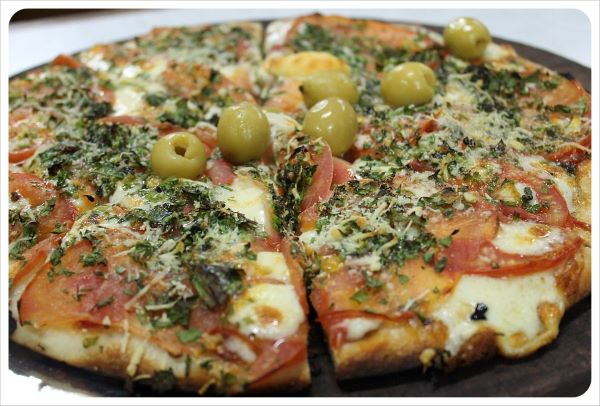
Argentine pizza occupies its own category and makes no apologies for it. It is not Italian pizza and it is not American pizza and it does not try to be either. The dough is thicker and breadier than a Neapolitan base, the mozzarella is applied in a thick, generous layer that forms a single unified blanket across the entire surface, and the tomato sauce underneath is restrained and slightly sweet. Pizza muzzarella, simply cheese pizza in the Argentine tradition, is the benchmark dish at any pizzeria in Buenos Aires.
When it is made properly with the right provolone-mozzarella blend and the right dough thickness, it is one of the more satisfying things you can eat. If you have been searching for the best pizza muzzarella argentina near me and finding only Italian or American interpretations, this guide helps you find the right version.
What Pizza Muzzarella Argentina Actually Is
Argentine pizza traces its roots to the Italian immigrant communities of Buenos Aires, particularly from Genoa and Naples, but what developed over more than a century is a distinct local tradition. The Buenos Aires pizzeria, called pizzeria porteña, produces a pizza that has evolved away from its Italian origins and become something specific to that city and that culture.
The dough in an Argentine pizza muzzarella is thicker than most Italian styles but not as deep as a Sicilian. It is made with a simple flour, water, yeast, and olive oil recipe, proofed long enough to develop flavor, and baked on a stone or metal surface until the base is fully cooked through with some color on the bottom and a soft, slightly chewy interior crumb.
The cheese is the most visually distinctive element. Argentine pizzerias use a blend of mozzarella and a mild semi-hard cheese, often called muzzarella in the Argentine context to distinguish it from Italian mozzarella, applied in a very thick layer that covers the entire surface without gaps. The cheese melts into a single, unified blanket rather than individual pools. The quantity of cheese used is significantly more than an Italian or American cheese pizza of the same size.
The tomato sauce, called salsa de tomate in the Argentine context, is smooth, lightly sweetened, and applied in a relatively thin layer beneath the cheese. It is present as a flavor element rather than a dominant component. The cheese is the star.
When you search for the best pizza muzzarella argentina near me, the thick cheese blanket and the specific dough texture are the two things that identify the authentic Argentine style from other pizza traditions.
Where to Find It
Argentine restaurants and Argentine pizzerias are the primary source. Any Argentine restaurant with a full menu will typically include pizza as a standard offering because pizza is deeply embedded in Buenos Aires food culture. Dedicated Argentine pizzerias, less common outside of cities with large Argentine communities, are the best source.
Argentine communities in Miami, New York, Los Angeles, Chicago, and Houston have enough Argentine restaurants and pizzerias to make the search productive. Cities with smaller Argentine populations may have a single Argentine restaurant that carries pizza muzzarella on a broader menu.
Argentine bakeries and prepared food operations occasionally sell pizza muzzarella by the slice or tray as a prepared food item. These are worth checking in cities where dedicated Argentine restaurants are scarce.
Argentine home cooks and community vendors sometimes make and sell pizza muzzarella through batch orders on Instagram and Facebook. The quantity of cheese required and the dough preparation make this a more involved home production than standard food items, so it appears less frequently than empanadas or tartas in home cook offerings.
How to Search More Effectively
A search for the best pizza muzzarella argentina near me may surface Argentine restaurants without specifying whether they carry pizza. Here is how to narrow the search:
Search Google Maps for Argentine restaurant in your city and browse menus for pizza muzzarella or pizza porteña. A restaurant that lists pizza alongside empanadas and milanesas is operating with a full Buenos Aires-style menu and is more likely to make the pizza in the Argentine tradition.
Search Instagram with “pizza muzzarella argentina” or “pizza porteña” plus your city name. Argentine restaurant accounts and home cook vendors post photos of the finished pizza, and the thick cheese blanket characteristic of Argentine pizza is immediately identifiable in photos.
Search Facebook for Argentine community groups in your city and ask where to find Argentine pizza specifically. Argentine expats are particular about their pizza and will direct you to the closest authentic option or confirm that none exist locally.
Search Yelp for Argentine restaurants and read reviews that mention pizza. Reviewers will describe whether the cheese was thick and properly melted, whether the dough had the right texture, and whether the experience matched what they expected from an Argentine pizzeria.
What Good Pizza Muzzarella Argentina Should Look Like
Once you find a source, a few things confirm whether the kitchen made it in the Argentine style.
The cheese layer. Thick, uniform, and covering the entire surface without gaps. When the pizza is cut, the cheese should pull slightly and form strings rather than remaining completely firm. The top surface should be lightly golden in spots from the oven heat, not brown or burned. The depth of the cheese layer is the most immediate visual marker of an Argentine pizza versus an Italian or American one.
The dough thickness. Visible in the crust at the edge, which should show a full, bread-like crumb with some interior pockets from fermentation. The base should be fully cooked, with a slight crust on the bottom that holds the slice without flopping. An undercooked base is pale and doughy. An overcooked base is hard and cracker-like.
The sauce. A thin, smooth layer visible only at the edges where the cheese does not fully cover it. The sauce should be lightly sweet and tomato-forward without garlic or heavy herb seasoning. Argentine pizza sauce is simpler than most Italian pizza sauces.
The aroma. When the pizza arrives at the table, the smell should be of melted cheese and toasted dough. The cheese should have fully melted and have a slightly browned top surface rather than looking raw or pale.
The weight. An Argentine pizza muzzarella is heavier than it looks because of the generous cheese application. A slice that feels light is using insufficient cheese for the style.
Ordering and Eating Tips
Argentine pizza is traditionally eaten at the table rather than by the slice at a counter, though slice service is common at casual pizzerias in Buenos Aires. A full pizza serves two to four people depending on size and appetite.
The Argentine tradition includes eating pizza with faina, a chickpea flatbread similar to a socca, placed directly on top of the pizza slice and eaten together. If the restaurant offers faina, ordering it alongside the pizza muzzarella is worth doing for the complete experience.
Pizza muzzarella is also traditionally ordered with moscato, a sweet Argentine sparkling wine, or with a glass of regular red wine. The sweetness of the moscato against the savory cheese is a specific pairing in Buenos Aires pizzeria culture.
Do not compare Argentine pizza muzzarella to Italian or American cheese pizza and expect the same experience. The dough thickness, cheese quantity, and sauce restrain are intentional stylistic choices, not technical failures. Evaluating it on its own terms rather than against a different pizza tradition gives the dish a fair assessment.
Pricing Expectations
A full pizza muzzarella argentina at an Argentine restaurant typically runs between $18 and $32 depending on the size, the market, and the restaurant’s positioning. Individual slices at Argentine-style casual pizzerias, where they exist, run between $4 and $8 per slice. Higher-end Argentine restaurants in major cities may price a full pizza at the higher end of the range.
Key Takeaways
- The best pizza muzzarella argentina near me is most reliably found at Argentine restaurants with full Buenos Aires-style menus and dedicated Argentine pizzerias in cities with established Argentine communities.
- Argentine pizza muzzarella uses a thicker, bread-like dough, a thick unified blanket of muzzarella cheese covering the entire surface, and a restrained, lightly sweet tomato sauce. It is a distinct tradition from Italian and American pizza.
- The thick, uniform cheese blanket covering the entire surface is the primary visual marker. A pizza with sparse or uneven cheese is not made in the Argentine style.
- Search Instagram with “pizza muzzarella argentina” or “pizza porteña” plus your city name for the most visually useful results.
- Argentine community Facebook groups are a reliable resource for finding which local restaurants make pizza in the genuine Buenos Aires tradition rather than a hybrid version.
- If available, order faina alongside and eat it placed directly on top of the pizza slice. This is the traditional Buenos Aires way to eat pizza muzzarella.
- Pair with moscato or a light red wine following the Buenos Aires pizzeria tradition.
- Expect to pay $18 to $32 for a full pizza at a sit-down Argentine restaurant and $4 to $8 per slice at casual Argentine pizzerias.