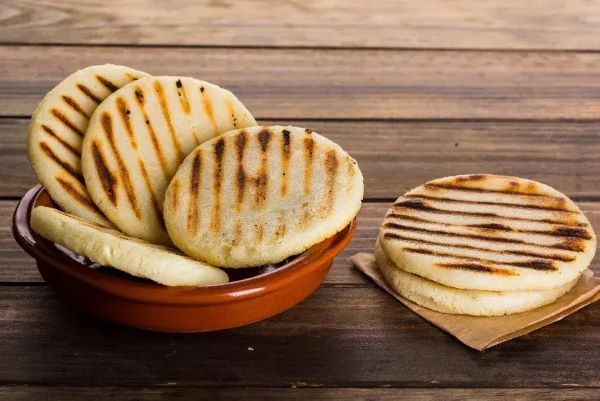
Arepa antioquena is one of the most straightforward and most satisfying things in Colombian baking, which is why it surprises people who have only encountered other arepa styles. It is a thick, white corn arepa made from ground white corn masa mixed with fresh white cheese and a small amount of salt, cooked on a griddle until the exterior develops golden spots and the interior becomes soft and slightly pillowy, with the cheese integrated throughout rather than placed on top.
In Antioquia and the coffee-growing region of Colombia called the Eje Cafetero, this arepa is eaten at every meal, served with butter while warm, paired with hot chocolate or tinto coffee, and treated as the bread of the region in the same way that tortillas function in Mexican cooking. If you have been searching for the best arepa antioquena near me and finding versions that are flat, thin, or missing the cheese interior, this guide gives you a better path to finding the authentic version.
What Arepa Antioquena Actually Is
The arepa antioquena comes from the Antioquia department and the surrounding Paisa region of Colombia, which encompasses Medellin and the surrounding coffee-growing municipalities. The Paisa identity in Colombia is strongly tied to this arepa, and Colombians from other regions recognize the antioquena style immediately by its thickness, its white color, and its slightly pillowy interior.
The masa for arepa antioquena uses white corn that has been nixtamalized, dried, and ground into a flour, called masarepa blanca, combined with fresh white cheese called queso blanco or cuajada, water, and salt. The cheese is mixed directly into the masa rather than added as a filling or topping, which distributes it evenly throughout the arepa and gives every bite a consistent cheese flavor rather than concentrating it in one area.
The resulting masa is shaped into thick discs, typically about two centimeters deep and ten to twelve centimeters across, and cooked on a dry or lightly greased griddle at medium heat. The extended cooking time compared to a thin arepa allows the interior to cook through completely while the exterior develops the golden spots from griddle contact that are one of the visual markers of a properly made antioquena.
The cheese in the masa also affects the texture. As the arepa cooks, the cheese proteins interact with the corn masa to produce an interior that is softer and more cohesive than a plain corn arepa. This slight pillowy quality is one of the most distinctive things about the antioquena style.
When you search for the best arepa antioquena near me, the thickness, the white color, the cheese integrated throughout the masa, and the slightly pillowy interior are the characteristics that confirm you are looking at the right product.
Where to Find It
Colombian bakeries and panaderias in cities with Colombian communities are the primary source. A Colombian panaderia that carries regional Colombian products and serves a Paisa or Antioquean clientele will carry arepa antioquena as a standard breakfast item. Cities with larger Colombian populations including Miami, New York, Houston, Los Angeles, and Chicago have enough Colombian bakeries to make the search productive.
Colombian restaurants and cafes that serve traditional breakfast menus from the Paisa region sometimes carry arepa antioquena specifically. A restaurant that offers hot chocolate santafereño alongside traditional Colombian breakfast items is more likely to understand regional distinctions than a generalist Latin American restaurant.
Colombian home cooks and community vendors from Antioquia and the Eje Cafetero region are often the most reliable source in cities without dedicated Paisa bakeries. Instagram and Facebook groups for Colombians in your city, particularly those from Medellin, Manizales, Pereira, and Armenia, will surface vendors who make arepa antioquena from the correct regional recipe.
Latin American grocery stores with a Colombian customer base sometimes carry fresh arepa antioquena in the refrigerated section or sell them at a prepared food counter. These are worth checking when bakery options are not available.
How to Search More Effectively
A direct search for the best arepa antioquena near me will return some Colombian restaurants and bakeries. Here is how to narrow it down:
Search Google Maps for Colombian bakery in your city and browse photo sections for arepa displays. A bakery that shows thick, white, griddle-cooked arepas with golden spots in their display case photos is likely making the antioquena style.
Search Instagram with “arepa antioquena” plus your city name. Colombian bakers and vendors from the Paisa region post photos of their arepas regularly, and the thick, white, spotted arepa is immediately identifiable from a photo.
Search Facebook for Colombian community groups in your city, specifically asking about Paisa food or arepa antioquena. Colombians from Antioquia are specific about their regional food and will give you direct recommendations rather than generic suggestions.
Ask any Colombian bakery or restaurant directly whether their arepas are the antioquena style with cheese mixed into the masa. This specific question will immediately distinguish a source making the correct regional version from one making a different arepa style.
What Good Arepa Antioquena Should Look Like
Once you find a source, a few things confirm the quality.
The thickness. Noticeably thick, roughly two centimeters deep, compared to the thin flat arepas of other Colombian regions or of Venezuelan cooking. The thickness is not accidental. It is structural to the style and produces the pillowy interior that defines the antioquena experience.
The color. White to off-white throughout, with golden spots on the flat surfaces where the griddle contact caramelized the corn masa. The spots should be present on both sides from even cooking. A uniformly pale arepa without golden spots was cooked at too low a temperature or for insufficient time.
The cheese distribution. Visible throughout the cut cross-section when the arepa is broken or cut. Every part of the interior should contain cheese. If the cheese is concentrated in one area or absent from most of the interior, it was not properly mixed into the masa before shaping.
The interior texture. Soft, cohesive, and slightly pillowy. The arepa should yield to gentle pressure and have a slight spring-back rather than feeling dense and compact. A dense, heavy interior without any softness indicates insufficient cheese in the masa or a masa that was over-worked before cooking.
The aroma. Warm corn and fresh cheese when the arepa comes off the griddle. A properly made arepa antioquena smells of both the toasted corn masa and the mild, fresh dairy of the cheese. An arepa with no dairy aroma was made with insufficient cheese.
Ordering and Eating Tips
Eat arepa antioquena warm, ideally within minutes of coming off the griddle. The interior is at its softest and the cheese flavor is most prominent when the arepa is hot. A cold arepa antioquena that has been sitting for an hour has lost most of its best qualities.
Apply butter while the arepa is still warm enough to melt it. The butter absorbs into the warm corn masa and adds richness that complements the fresh cheese inside. This is the traditional Paisa way to eat the arepa antioquena and the combination of melted butter, warm corn, and fresh cheese is exactly why this arepa is the defining bread of the region.
Pair with Colombian hot chocolate or tinto. The bitterness of the chocolate or coffee against the mild sweetness of the corn and cheese is the traditional Paisa breakfast combination that makes the arepa taste better in context than eaten alone.
Order more than one. Arepa antioquena is small enough that one serves as a snack rather than a full breakfast. Two to three arepas alongside hot chocolate is the traditional Paisa morning meal format.
Pricing Expectations
Individual arepa antioquenas at a Colombian bakery typically run between $2 and $5 depending on the size and the market. Home cook and vendor versions sold through batch orders are often priced similarly. At a Colombian restaurant where it is served as part of a breakfast plate, it may be included in the set meal price of $8 to $15.
Key Takeaways
- The best arepa antioquena near me is most reliably found at Colombian bakeries serving a Paisa clientele, through home cook vendors from Antioquia and the Eje Cafetero on Instagram and Facebook, and at Colombian restaurants with traditional regional breakfast menus.
- Arepa antioquena is a thick white corn arepa with fresh white cheese mixed directly into the masa, cooked on a griddle until golden spots develop on both surfaces. The cheese is integrated throughout, not added as a topping.
- The thickness of roughly two centimeters, the white color with golden griddle spots, and the cheese visible throughout the interior are the three primary quality markers.
- Ask directly whether the cheese is mixed into the masa or applied to the surface. This question confirms which style of arepa you are getting.
- Search Instagram with “arepa antioquena” plus your city name and check Colombian community Facebook groups specifically for members from Medellin or the broader Antioquia region.
- Apply butter while warm and eat immediately. The interior softness and cheese flavor both diminish as the arepa cools.
- Pair with Colombian hot chocolate or tinto for the traditional Paisa breakfast combination.
- Expect to pay $2 to $5 per arepa at a Colombian bakery or from a home cook vendor.