If you have ever watched the Winter Olympics and wondered how do skeleton athletes steer that thing, you are in good company. A slider lies face down, head first, chin a few centimeters above the ice, and rockets down a frozen track at highway speeds. There is no wheel. There is no joystick. There are no brakes. From the outside it looks like the athlete is just along for the ride, holding on and hoping for the best.
The truth is more interesting. Skeleton athletes have real, precise control over their sled. They just do it with their bodies instead of any visible mechanism. Once you understand the method, the sport stops looking like a daredevil stunt and starts looking like a skill that takes years to master.
What a Skeleton Sled Actually Is
Before getting into the steering, it helps to picture the equipment. A skeleton sled is a low, heavy tray made of steel and a carbon or polyester shell. It rides on two polished steel runners, the long blades that touch the ice. Those runners are the only contact point between the sled and the track, and they are extremely sensitive. Even a tiny scratch on a runner can change how the sled behaves on a run.
The sled has handles for pushing at the start and bumpers to protect the athlete from the walls. What it does not have is any steering hardware. No tiller, no pedals, no cables. So the natural question is the one everyone asks: how do skeleton athletes steer that thing when the sled gives them nothing obvious to work with?
How Do Skeleton Athletes Steer That Thing?
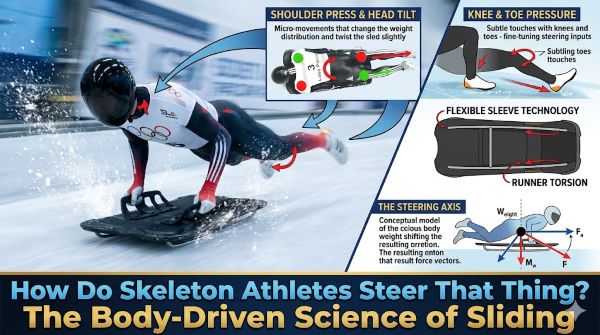
The short answer is body pressure. Skeleton athletes steer by shifting their weight and pressing specific parts of their body against the sled. The main inputs come from the shoulders, the knees, and the toes. A slider drives a shoulder into one side of the sled, or presses down with a knee, and that pressure flexes through the frame and changes how the steel runners grip the ice. That change in runner contact is what actually turns the sled.
So when people ask how do skeleton athletes steer that thing, the real answer is that they bend and load the sled in tiny ways. Press the right shoulder and apply a little knee pressure, and the sled drifts one direction. Do the opposite, and it goes the other way. The tips of the shoes, fitted with spikes for the start, also help nudge the sled and fine tune the line.
The Role of Body Weight
Weight distribution sits at the center of everything. A skeleton sled responds to where the athlete’s mass sits at any given moment. Lying still and centered keeps the sled tracking straight. Shifting weight slightly toward one runner begins a turn.
People who ask how do skeleton athletes steer that thing often expect some dramatic motion, like a swimmer kicking or a driver yanking a wheel. It is the opposite. The smallest shift in body weight can separate a fast, clean line from a slide that spins out of control. A slider might move only a few inches, and that is enough at these speeds. The sled magnifies every input, so a small lean becomes a real change in direction.
This is why body awareness matters so much. A skeleton athlete has to know exactly where their weight is and how much they are applying, all while moving at speed and seeing very little of what is ahead.
Why a Light Touch Wins
Here is the part that surprises most newcomers. The goal is to steer as little as possible. The fastest way down a track is the straightest, smoothest line, so every unnecessary correction costs time. Good sliders try to set up each corner early and let the sled run rather than fighting it the whole way down.
Steering too hard creates a skid. When the runners lose their clean grip, the sled scrubs speed and the athlete loses precious time. Steering too little is just as bad. If a slider does not guide the sled at all, the track takes over, throwing the sled into walls and ruining the run, or worse, causing a crash. So the answer to how do skeleton athletes steer that thing is not just about which body parts they use. It is about restraint. The best athletes apply the gentlest possible input at exactly the right moment.
That balance between too much and too little is the whole craft. A slider wants enough pressure to hold the ideal line and not one bit more.
The “Feel” That Separates the Best
Ask any slider how do skeleton athletes steer that thing at the top level, and they will eventually talk about feel. Skeleton happens fast, and athletes cannot rely on watching every turn approach. With their chin near the ice and the world rushing by, much of the run depends on sensing the sled and the track through their body.
Sliders describe developing a sense of when to let the sled run free and when to apply a touch of pressure. That feel comes only from repetition. Athletes take run after run on the same tracks, learning the rhythm of each corner and how their sled reacts. Over time they build a kind of muscle memory that lets them steer almost on instinct.
This is similar to how a downhill skier hunts for the quickest line on a slope. Skeleton drivers study every twist and turn of a track and figure out where to enter a corner, where to drift, and where to stay perfectly still. Two sliders on identical sleds can post very different times based on this feel alone.
Reading the Track
Knowing how sliders control the sled also means understanding how much homework goes into a single run. Before they ever compete, athletes walk the track on foot. They study each curve, note where the ice pushes the sled, and plan the line they want to take.
Every track is different. Some have long sweeping turns, others have tight technical sections that come one after another. A slider memorizes the sequence so their body can react before a corner arrives instead of after. By the time they push off, they already have a mental map of where to apply pressure and where to relax.
This preparation is part of the answer too. The steering inputs only work if the athlete knows when to use them, and that knowledge comes from studying the track long before the race.
The Start Counts as Well
Steering does not begin once the athlete is lying down. The start sets up the entire run. A slider sprints while pushing the sled, then loads onto it smoothly without throwing it off line. A clean, straight load means the sled is already tracking well when the steering begins.
A sloppy start forces the athlete to correct early, and as we know, every correction costs speed. So part of the steering picture is realizing that good control starts with a powerful, balanced push and a careful jump onto the sled. Get that wrong and the slider spends the top of the track fixing mistakes instead of carrying speed.
When Steering Goes Wrong
It helps to see the failure modes. When a slider oversteers, the sled skids sideways, the runners chatter, and the line falls apart. The athlete then has to fight to recover, which almost always means a slower time. When a slider understeers, the sled climbs too high on a wall or drops too low, and the track dictates the path instead of the athlete.
Either way, the run suffers. This is why the question how do skeleton athletes steer that thing has such a layered answer. Anyone can lean on a sled. Doing it with the precise amount of pressure, at the exact right moment, while moving at speed, is what takes real skill. The margin for error is tiny when your chin sits a few centimeters from the ice.
Can a Beginner Learn It?
Yes, and many do, just not at full speed right away. New sliders start from lower points on the track to keep speeds manageable while they learn the basics of pressure and weight shift. As their feel develops, they move higher up and take on faster runs.
The learning curve is steep because the inputs are so subtle. A beginner tends to overcorrect, fighting the sled and losing time, while an experienced slider looks almost motionless. That stillness is the goal. So the final piece of the puzzle is patience. The control looks effortless only because the athlete has practiced the small movements thousands of times.
Key Takeaways
- The question how do skeleton athletes steer that thing has a simple core answer: they steer with their bodies, not with any mechanism on the sled.
- The main steering inputs come from the shoulders, knees, and toes, which press against the sled and change how the steel runners grip the ice.
- Body weight is central, since a shift of just a few inches can change the sled’s direction at high speed.
- A skeleton sled has no wheel and no brakes, so all control depends on subtle pressure and weight distribution.
- Less is more, because the fastest line is the straightest one and every unnecessary correction scrubs speed.
- Steering too hard makes the sled skid, while steering too little lets the track take over and can cause a crash.
- Elite sliders rely on feel, a sense built through repetition of when to steer and when to let the sled run.
- Athletes walk and study each track in advance so their bodies can react to corners before they arrive.
- A clean, balanced start sets up the whole run, since a sloppy load forces early corrections that cost time.
- Beginners learn the same skills from lower, slower starting points and work up as their feel for the sled develops.