Your tires are the only thing between your car and the road. Under-inflated tires wear faster, waste fuel, and handle poorly. Over-inflated tires ride hard and can blow out unexpectedly. The fix is simple: check your tire pressure regularly. Here’s how to do it and what numbers to look for.
Most people avoid this task because they’re not sure what to do or where to start. The truth is learning how to check tire pressure takes five minutes and requires almost no tools.
Why Tire Pressure Matters
Before we talk about how to check tire pressure, let’s talk about why it matters in the first place.
Tire pressure affects everything from fuel economy to safety. When your tire psi drops even 10 percent below the recommended level, rolling resistance increases. Your engine works harder to move the car, which burns more gas. A tire that’s seriously underinflated can overheat and fail on the highway. A tire that’s overinflated rides stiffly and can puncture easily if you hit a pothole.
Proper tire pressure also keeps the weight of your car distributed evenly across the tire’s contact patch with the road. This improves traction, shortens stopping distance, and reduces wear on the sides of the tire. Checking tire pressure every month (and before long trips) is one of the easiest maintenance tasks you can do to protect your investment.
What Should My Tire Pressure Be?
This is the question that stops most people from learning how to check tire pressure. The answer depends on your specific vehicle.
Every car has a recommended tire pressure, and it’s not the number on the sidewall of your tire. The number stamped on the tire itself is the maximum pressure that tire can safely hold. Your car’s recommended pressure is lower, and that’s what you should aim for.
To find what should my tire pressure be, look for a sticker inside the driver’s door jamb or in your owner’s manual. The sticker shows the recommended tire psi for both the front and rear tires (which are sometimes different) and what size tire your car uses. Write this number down and keep it in your phone for future reference.
Normal tire pressure for most passenger cars falls between 30 and 35 psi. Trucks and SUVs often run between 32 and 42 psi because they carry more weight. But don’t guess. Find your car’s specific number and use that.
Understanding Tire PSI and Normal Tire Pressure
PSI stands for pounds per square inch. It’s the measurement of how much the air inside your tire pushes outward against the tire walls and the road.
Normal tire pressure changes with the temperature outside. Cold weather lowers tire pressure because air contracts when it cools. For every 10-degree drop in temperature, tire psi can drop by about 1 psi. So if you check your tire pressure in winter, it will be lower than in summer. This is normal, but it’s also why you should check more often when the seasons change.
What should tire pressure be in winter? The same as the manufacturer recommends, but understand that you may need to add air in cold months to reach that target. In summer, your tire pressure will naturally run a bit higher due to heat, which is fine as long as you don’t exceed the maximum.
Tire manufacturers design their recommendations around a baseline temperature. Most recommendations assume checking tires when they’re cold, meaning the car has not been driven for at least three hours. Driving heats up tires and temporarily raises the psi, so always check tire pressure when your tires are cold for an accurate reading.
How to Check Tire Pressure: Step by Step
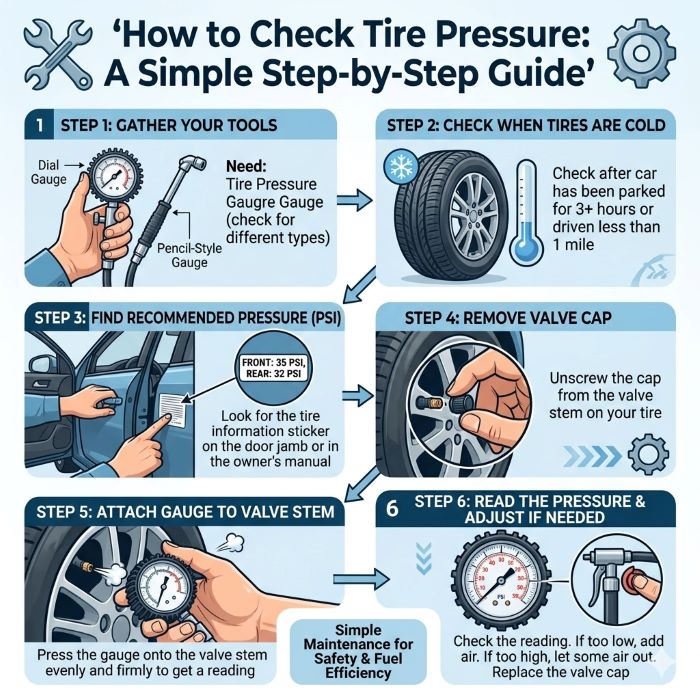
Learning how to check tire pressure is straightforward. Here’s what you need to do.
Step 1: Get a Tire Gauge
You need a tire pressure gauge. This is a small tool that measures psi. You have three options: a stick gauge (cheapest and least accurate), a dial gauge (mid-range, more accurate), or a digital gauge (most expensive, most accurate). For regular home checking, a dial or digital tire pressure gauge works fine. They cost $10 to $25.
Step 2: Check When Tires Are Cold
Always check your tire pressure when the tires are cold. This means the car has not been driven for at least three hours, or you’re checking first thing in the morning before driving. Driving generates heat, which inflates the tire temporarily and gives you a false high reading.
Step 3: Remove the Valve Cap
On each tire, you’ll find a small valve stem poking out from the wheel. It’s a small protrusion, usually made of rubber or metal. Unscrew the cap on top of the valve stem and set it aside somewhere you won’t lose it. You’ll screw it back on when you’re done.
Step 4: Press the Gauge onto the Valve
Take your tire air pressure gauge and press it firmly onto the valve stem. You’ll hear a slight hiss of air. This is normal. Push straight on with the gauge perpendicular to the valve stem to get a good seal. Don’t let air escape while you’re measuring.
Step 5: Read the Pressure
With a dial gauge, the needle shows the psi reading on the dial face. With a digital gauge, the number displays on a small screen. With a stick gauge, a rubber rod extends and shows the psi on markings on the rod. Note the reading.
Step 6: Compare to Your Target
Compare your reading to the tire psi number from your car’s door jamb sticker. If the reading is low, you need to add air. If it’s high, you may need to release a tiny bit of air (only if it’s significantly over).
Step 7: Replace the Valve Cap
After you’ve taken your reading, screw the valve cap back on. Do this for all four tires. Some cars have a fifth tire (spare), and you should check that one too, though it matters less since you rarely drive on it.
What Should Tire Pressure Be: Common Numbers
Here are normal tire pressure ranges by vehicle type.
Sedan or compact car: Usually 30 to 35 psi. Check your door jamb to confirm.
SUV or crossover: Usually 32 to 42 psi depending on size. Heavier vehicles run higher pressures.
Truck: Usually 35 to 45 psi. Some trucks that tow trailers run even higher.
Luxury sedan: Some high-end cars use lower pressures like 28 to 32 psi for a smoother ride.
Again, do not rely on these ranges. Your exact vehicle has an exact recommended pressure. Find that number and use it.
Where to Find Free Air for Tires
If your tires are low and you need to add air, you have several options.
Gas Stations
Most gas stations have an air pump. Some are free. Some charge 50 cents to $2 per use. Ask at the counter if you’re not sure. The pump will have a tire air pressure gauge built in, so you can check your pressure while you’re adding air. Loosen the valve cap, attach the hose from the pump, and hold it steady while air flows in. The gauge on the pump shows your current psi, and you can stop when you reach your target.
Tire Shops
Any tire shop will add air for free. They may try to sell you tires or other services, but if you just need air, they’ll help you out. A tire shop also has a professional tire air pressure gauge they can use if you want an expert reading.
Car Dealerships
Many car dealerships will add air for free, especially if you’re a customer who has purchased from them before.
Costco and Sam’s Club
If you’re a member, these warehouse clubs offer free air at their gas pumps.
Walmart
Some Walmart locations have air pumps available to customers at no charge.
Your Home (if you have a compressor)
A home air compressor is useful if you check tire pressure frequently. A small plug-in compressor costs $30 to $60. You attach it to your tire and run it until you reach the desired psi. This is faster than going to a gas station and gives you flexibility to check anytime.
Using a Tire Air Pressure Gauge at Home
A tire air pressure gauge is your main tool, so it’s worth choosing a good one.
A dial tire pressure gauge shows pressure on a round dial with a needle. These are durable, easy to read, and cost around $15. They’re accurate to within 1 or 2 psi.
A digital tire air pressure gauge displays the pressure as a number on a small LCD screen. These are the most accurate home option, typically within 0.5 psi. They cost $20 to $40. Digital gauges often include features like an auto-shutoff and a backlit screen for checking tires in low light.
A stick gauge is the cheapest option (under $5) but the least accurate. The reading can vary depending on how you read the markings. Avoid these if you want reliable results.
For regular home use, a dial or digital tire pressure gauge will serve you well. Both are more accurate than relying on a gas station pump’s gauge.
How Often Should You Check Tire Pressure?
Check your tire pressure at least once a month. Add an extra check before any long road trip. Also check after big temperature swings, especially when seasons change. If a tire pressure warning light comes on in your car, check all four tires immediately.
Some cars have tire pressure monitoring systems (TPMS) that alert you when tire pressure drops. These are helpful, but they’re not a replacement for regular manual checks. The sensor can fail, or the system may not catch gradual pressure loss.
Key Takeaways
- How to check tire pressure starts with finding your car’s recommended tire psi on the driver’s door jamb sticker, not the number on the tire sidewall.
- A tire pressure gauge (dial or digital) costs $10 to $40 and is essential for checking pressure accurately at home.
- Check your tire psi when tires are cold, meaning the car has not been driven for at least three hours.
- Normal tire pressure for passenger cars is between 30 and 35 psi, but your specific vehicle may differ.
- What should tire pressure be in cold weather? The same as the manufacturer recommends. Air contracts in cold temperatures, so you may need to top up in winter to reach the target.
- What psi should my tires be is answered on your car’s door jamb sticker. Write this number down and refer to it monthly.
- Free air for tires is available at most gas stations, tire shops, dealerships, and warehouse clubs like Costco and Sam’s Club.
- Tire air near me is easy to find with a quick search for “air pump near me” or by stopping at any major gas station.
- The most common mistake people make is comparing their tire psi to the maximum psi printed on the tire, which is always higher than what your car actually needs.
- A tire air pressure gauge built into a gas station pump is convenient but less accurate than a portable dial or digital gauge you keep at home.
- Cold weather, hot weather, and high-speed driving all affect tire pressure temporarily, so check when conditions are neutral and tires are cold.
- Proper tire pressure improves fuel economy, extends tire life, and keeps your car handling smoothly and safely.