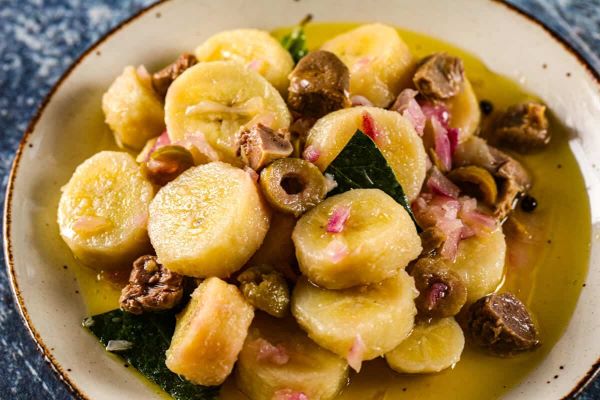
Guineos en escabeche is one of those Puerto Rican dishes that does not translate easily into any other culinary tradition. Green bananas, cooked until tender and then marinated in a vinegar-based escabeche with olive oil, onion, garlic, green olives, and peppercorns, served cold or at room temperature as a side dish or a main course component. It sounds unusual if you have not encountered it, and it makes complete sense once you taste it. The starchiness of the green banana, which behaves more like a potato than a fruit at this stage of ripeness, absorbs the vinegary escabeche during marination and becomes deeply flavored and slightly acidic in a way that plain boiled green banana cannot be.
It is practical food, budget food, and deeply traditional food in Puerto Rican cooking, and finding the best guineos en escabeche near me means knowing which restaurants and home cooks treat this humble preparation with the attention it deserves.
What Guineos en Escabeche Actually Is
Guineo is the Puerto Rican term for banana, and in the culinary context refers specifically to the green, unripe banana used for cooking rather than the ripe banana eaten as a fruit. At this stage, the banana is starchy, firm, and savory in character, with no sweetness from natural sugars and a slightly astringent quality that disappears during cooking.
The preparation begins by boiling the green bananas in salted water, sometimes with a small amount of oil to prevent discoloration of the starchy flesh. The bananas can be boiled in their peel and then peeled after cooking, or peeled before boiling. The peel-on method is traditional and helps the banana hold its shape during cooking. The cooked bananas are then sliced into rounds, typically about two centimeters thick, and placed in the escabeche marinade while still warm so they absorb the pickling liquid effectively.
The escabeche is made from olive oil, white or red wine vinegar, sliced onion, garlic, green olives, whole peppercorns, and sometimes sliced sweet or hot peppers and bay leaves. The combination of olive oil and vinegar creates a marinade that is simultaneously tangy, slightly bitter from the olive oil, and savory from the olives and garlic. The banana slices sit in this marinade for at least several hours and ideally overnight, absorbing the pickling flavors throughout.
Guineos en escabeche can be made with just the banana, in which case it functions as a side dish or a component of a cold plate. Many versions add protein, typically salt cod, canned tuna, or canned sardines, which transforms the dish into a more substantial preparation that functions as a main course. The salt cod version, guineos en escabeche con bacalao, is one of the most traditional and most satisfying combinations.
When you search for the best guineos en escabeche near me, the proper sourness and depth of the escabeche, the texture of the banana slices, and the overnight marination that allows full flavor penetration are the quality markers to look for.
Where to Find It
Puerto Rican restaurants with traditional menus carry guineos en escabeche as a side dish, an appetizer, or a component of a cold plate. A restaurant that carries a variety of traditional Puerto Rican preparations including gandules, pasteles, and other traditional items is more likely to offer guineos en escabeche than one with a more simplified menu.
Puerto Rican fondas and casual home-style restaurants in cities with Puerto Rican communities sometimes carry guineos en escabeche as a daily or weekly prepared item. These informal restaurants rotate their offerings based on what is being made for the community that day, and guineos en escabeche appears regularly as a traditional side or light meal.
Puerto Rican home cooks and community vendors are often the most reliable source, particularly for the traditional versions that include bacalao or canned fish alongside the bananas. Home cooks who grew up eating guineos en escabeche make it as a regular preparation and sell it through community networks with the overnight marination that produces the deepest flavor.
Latin American grocery stores with Puerto Rican clientele sometimes carry prepared guineos en escabeche in the refrigerated section or sell the ingredients for making it at home. Green bananas are widely available at Latin American markets year-round.
How to Search More Effectively
A direct search for the best guineos en escabeche near me will surface Puerto Rican restaurants in your area. Here is how to identify the ones making it properly:
Search Google Maps for Puerto Rican restaurant in your city and look for menus that list guineos en escabeche specifically. A restaurant that names this specific dish is treating it as a serious part of their offering rather than an occasional special.
Search Yelp for Puerto Rican restaurants and read reviews that mention guineos or escabeche. Reviewers who know the dish will describe whether the banana was properly cooked and marinated, whether the escabeche was properly sour and savory, and whether the olive oil and garlic were present throughout the marinade.
Search Instagram with “guineos en escabeche” plus your city name. Puerto Rican home cook vendors and restaurant accounts post photos of this dish, and the distinctive rounds of green banana in the escabeche marinade with visible olive oil, onion rings, and green olives is identifiable in a food photo.
Search Facebook for Puerto Rican community groups in your city and ask directly where to find guineos en escabeche. Puerto Ricans will give you specific recommendations for which local restaurant or home cook makes the most properly marinated and seasoned version.
What Good Guineos en Escabeche Should Look Like
Once you find a source, a few things confirm the quality.
The banana texture. Firm and slightly dense, holding its round slice shape without crumbling or falling apart. Properly cooked green banana for escabeche should be completely cooked through but not so soft that it loses structural integrity when lifted. A banana that disintegrates when touched was overcooked.
The marinade color. Slightly golden from the olive oil with visible vinegar liquid, onion rings that have softened slightly from marination, and green olive pieces distributed throughout. The marinade should look active and complex rather than a thin clear liquid with solid additions floating in it.
The sourness. Perceptible from the first bite. Guineos en escabeche should have a clear vinegar sourness that runs through the banana slices rather than just coating the surface. This sourness confirms the bananas were marinated for long enough to absorb the escabeche. A version that tastes primarily of plain cooked banana with a slight vinegar note on the surface was not marinated long enough.
The olive oil presence. A slight richness and slight bitterness from good olive oil present in every bite. The olive oil is not just a cooking medium but a flavor element in the escabeche, and it should be detectable alongside the vinegar acid.
The olives and garlic. Distributed through the preparation and detectable in every few bites. The green olives add brine and the garlic adds sharpness. Both should be clearly present rather than incidental.
Ordering and Eating Tips
Eat guineos en escabeche at room temperature rather than cold from refrigeration. Very cold escabeche has congealed olive oil that mutes the flavor and an unpleasantly firm banana texture. Allowing 15 to 20 minutes at room temperature before eating restores the liquid olive oil texture and brings the vinegar and garlic flavors into clearer focus.
Order the version with bacalao or canned fish if the restaurant or home cook offers it. The protein version is a more complete meal and the combination of the pickled green banana with the salt cod is one of the classic Puerto Rican flavor pairings.
Eat with white rice and avocado if available. The plain white rice absorbs the escabeche liquid and provides a neutral backdrop for the sour, savory banana. Avocado adds creaminess that balances the acidity of the marinade.
Ask whether the guineos en escabeche were marinated overnight. A version marinated for at least 12 hours will have the sourness and flavor penetration that makes this dish satisfying. A version marinated for only an hour or two will have surface flavor only.
Pricing Expectations
Guineos en escabeche as a side dish or appetizer at a Puerto Rican restaurant typically runs between $7 and $14. The version with bacalao or canned fish as a main course runs between $14 and $22. Home cook and community vendor versions sold by the container typically run $8 to $16 per portion.
Key Takeaways
- The best guineos en escabeche near me is most reliably found at Puerto Rican fondas and traditional restaurants and through Puerto Rican home cook vendors who marinate overnight for full flavor penetration.
- Guineos en escabeche uses cooked rounds of green banana marinated in a vinegar, olive oil, garlic, onion, and green olive escabeche. The overnight marination that allows the vinegar sourness to penetrate the banana slices is the most important preparation factor.
- Perceptible sourness running through the banana rather than only on the surface confirms proper marination time. Surface-only sourness means the preparation was not given enough marination time.
- Eat at room temperature, not cold. Congealed olive oil from refrigeration suppresses the flavor and produces an unpleasantly firm texture.
- Ask directly whether the guineos were marinated overnight. This single question predicts quality more reliably than any visual inspection.
- The version with bacalao is the most traditional and most complete preparation. Order it if available.
- Search Instagram with “guineos en escabeche” plus your city name and check Puerto Rican community Facebook groups for specific restaurant and vendor recommendations.
- Expect to pay $7 to $14 for a side serving and $14 to $22 for a main course version with fish at a Puerto Rican restaurant.