Empanadas exist across Latin America in enough variations that the differences between national traditions are worth understanding before you start searching. The empanada peruana has specific characteristics that distinguish it from Argentine, Chilean, or Venezuelan versions, and knowing those differences helps you identify whether what you have found when searching actually represents the Peruvian tradition.
If you have been searching for the best empanada peruana near me and finding versions that seem close but not quite right, or finding nothing at all outside of a Peruvian restaurant menu, this guide gives you a clearer target and a better search strategy.
What Makes Empanada Peruana Different
The Peruvian empanada has developed its own character within the broader Latin American empanada tradition. Several elements distinguish it from neighboring styles.
The dough. Peruvian empanada dough tends to be richer and slightly sweeter than Argentine or Chilean equivalents, with more fat in the dough producing a shorter, almost crumbly pastry that is closer in texture to a shortbread crust than to the more neutral Argentine lard pastry. This sweet-savory contrast between the slightly sweet pastry and the savory filling is one of the defining characteristics of the Peruvian style.
The baking method. Peruvian empanadas are almost always baked rather than fried, and the surface is brushed with egg wash before baking, producing a deep golden, slightly shiny exterior. Some versions receive a final light dusting of powdered sugar over the egg-washed surface before or after baking, which emphasizes the sweet-savory contrast of the pastry.
The filling. The most traditional Peruvian empanada filling uses ground beef cooked with onion, garlic, cumin, aji panca or aji amarillo paste, hard-boiled egg, raisin, and black olive. The raisin is not optional in the traditional version. It provides a faint sweetness that balances the savory beef and the slight heat from the aji paste, and it is one of the most recognizable elements of an authentic empanada peruana filling.
The size. Peruvian empanadas tend to be smaller than Argentine versions, roughly the size of a large hand rather than a full plate, and are typically served as starters or snacks rather than as main course portions.
When you search for the best empanada peruana near me, the slightly sweet pastry with a powdered sugar dusting, the raisin and olive in the filling, and the baked rather than fried preparation are the three things that identify the authentic Peruvian style.
Where to Find It
Peruvian restaurants are the most reliable source. A Peruvian restaurant with a traditional menu that goes beyond the internationally known dishes will carry empanadas peruanas as a starter. Restaurants that also carry causa, papa a la huancaina, and other cold starters are likely treating their empanadas with similar attention to traditional preparation.
Peruvian bakeries and panaderias in cities with Peruvian communities carry empanadas peruanas as a standard baked item sold throughout the day. These bakeries make empanadas in quantity and the versions available during peak hours, mid-morning and midday, are freshest.
Peruvian home cooks and community vendors selling through Instagram and Facebook batch orders frequently include empanadas peruanas because they are a practical batch-cook item that holds well and has broad appeal. Home cooks who make the filling from scratch with aji paste, raisins, and olives produce a version that is often better than high-volume bakery production.
Latin American food festivals and markets with Peruvian representation sometimes feature empanada vendors making the Peruvian style. These vendors are worth seeking out specifically because they are likely producing small batches with traditional preparation rather than commercial volume.
How to Search More Effectively
A search for the best empanada peruana near me will surface Peruvian restaurants in your area. Here is how to identify the ones making them properly:
Search Google Maps for Peruvian restaurant or Peruvian bakery and browse menus for empanadas. A restaurant that lists the filling components, including aji, raisin, and olive, is making the traditional version. A restaurant that simply lists beef empanada without specifics may be following a different tradition.
Search Instagram with “empanada peruana” plus your city name. Peruvian restaurant accounts and home cook vendors post photos of their empanadas, and the golden, slightly shiny baked exterior with an egg wash finish is visually distinctive from other empanada styles.
Search Facebook for Peruvian community groups in your city and ask where to find empanadas peruanas specifically. Ask whether the filling includes raisin and olive. This specific question will generate responses from community members who know the traditional preparation and can point you to sources that follow it.
Ask any Peruvian restaurant or bakery directly what goes into their empanada filling. A kitchen making the traditional Peruvian version will describe the aji paste, raisin, and olive as standard components. A kitchen using a simplified or adapted filling will describe something different.
What Good Empanada Peruana Should Look Like
Once you find a source, a few things confirm whether the preparation is authentically Peruvian.
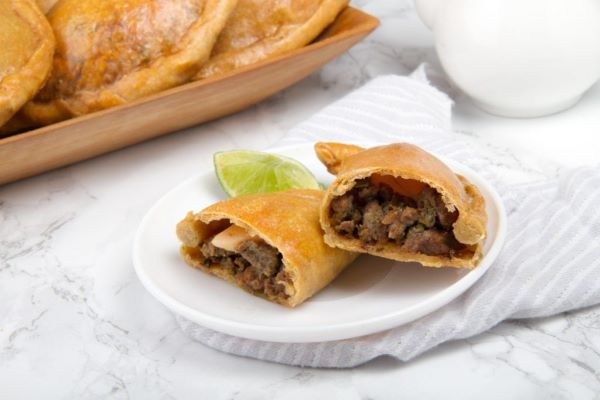
The exterior. Deep golden and slightly shiny from the egg wash, with a slight dusting of powdered sugar visible on the surface in some versions. The pastry should be fully baked through with no pale patches and should feel slightly firm when pressed. The sweet-savory contrast of the slightly rich pastry is detectable from the first bite.
The size. Smaller than a dinner-plate-sized Argentine empanada. The Peruvian style is roughly hand-sized, designed as a starter or snack portion rather than a full meal in itself.
The filling when broken open. Ground beef that is moist and cohesive, mixed with visible pieces of hard-boiled egg, black olive, and raisin distributed through the meat. The aji paste should give the filling a slightly reddish or orange tint. A filling that is only ground beef and onion without the olive and raisin is not the traditional Peruvian preparation.
The raisin. Present and identifiable in most bites. A kitchen that uses raisin sparingly may be hedging against customers who find it unexpected, but the raisin is a structural element of the filling and should be present throughout rather than appearing occasionally.
The seasoning. Warm and slightly spiced from the aji paste and cumin, with the raisin providing a gentle sweetness in the background. The filling should taste complete and slightly complex rather than simply savory. A flat, unseasoned filling was made without sufficient spice or with the wrong ratio of aji paste.
Ordering and Eating Tips
Empanadas peruanas work as a starter or snack. Order them alongside other cold Peruvian starters like papa a la huancaina or causa for a complete appetizer spread before a main course.
Eat them warm rather than hot. The pastry and filling both reveal more flavor as they cool slightly from the oven. A freshly baked empanada peruana eaten five minutes after coming out of the oven has a noticeably better flavor balance than one eaten immediately at peak heat.
The sweet-savory contrast of the pastry is intentional. If the slight sweetness of the pastry catches you off guard on first bite, recognize it as a deliberate design element of the Peruvian style rather than an error in preparation.
Ask whether the empanadas were baked that day. Peruvian empanadas are at their best within a few hours of baking. The pastry loses some of its crispness and the filling moisture redistributes over time, changing the texture experience notably by the second day.
Pricing Expectations
Individual empanadas peruanas at a Peruvian restaurant or bakery typically run between $4 and $7 each depending on the size and market. A serving of two to three as a starter at a sit-down restaurant runs between $10 and $18. Home cook and vendor versions sold through batch orders are typically priced similarly to bakery rates.
Key Takeaways
- The best empanada peruana near me is most reliably found at Peruvian restaurants with traditional menus, Peruvian bakeries in cities with Peruvian communities, and home cook vendors who specifically describe traditional filling components including aji paste, raisin, and olive.
- The Peruvian empanada uses a slightly sweet, rich baked pastry brushed with egg wash, sometimes dusted with powdered sugar, and filled with beef, hard-boiled egg, black olive, and raisin seasoned with aji paste and cumin.
- The raisin is a defining ingredient of the traditional Peruvian filling. Its absence means the kitchen is following a simplified or non-Peruvian preparation.
- The slightly sweet pastry in contrast with the savory filling is intentional and is one of the most distinctive characteristics of the Peruvian style compared to Argentine or Chilean versions.
- Search Instagram with “empanada peruana” plus your city name and check Peruvian community Facebook groups for vendors and bakeries making the traditional version.
- Ask any source directly whether the filling includes raisin and olive. A confident positive answer confirms the traditional preparation.
- Eat warm but not hot. The flavor balance of both pastry and filling is clearer five minutes after baking than immediately from the oven.
- Expect to pay $4 to $7 per empanada at a bakery or restaurant and $10 to $18 for a starter serving of two to three at a sit-down Peruvian restaurant.