Mango sticky rice has become one of the most recognizable Thai desserts outside of Thailand, which means it has also become one of the most frequently disappointing when a restaurant cuts corners on the two components that actually matter. The sticky rice needs to be cooked correctly and soaked in the right coconut cream mixture. The mango needs to be ripe enough to be fragrant and sweet on its own. When both of those things are right, the dish is extraordinary in its simplicity. When either one is wrong, the whole thing falls apart.
If you have been searching for mango sticky rice near me and keep finding versions with underripe mango, gluey rice, or watery coconut sauce, this guide helps you find a kitchen that takes the dish seriously and know what you are looking for when you sit down.
What Mango Sticky Rice Actually Is
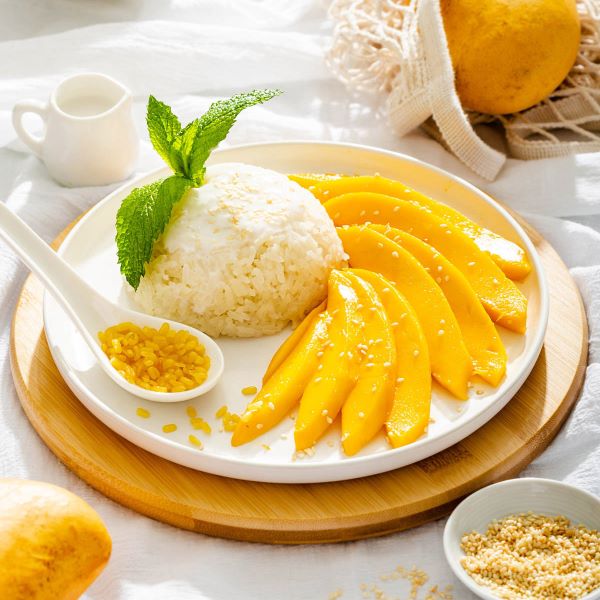
The Thai name is khao niao mamuang, which translates directly as glutinous rice mango. The rice used is Thai glutinous rice, also called sweet rice or sticky rice, which is a different variety from standard long-grain or jasmine rice. It is soaked overnight, then steamed in a bamboo basket over boiling water rather than cooked in a pot. The steamed rice is still slightly firm and carries a natural sweetness from the starch.
While the rice is still hot, it is mixed with a sweetened coconut cream sauce made from full-fat coconut milk, palm sugar or regular sugar, and a pinch of salt. The hot rice absorbs the coconut cream as it sits, becoming fragrant and slightly sticky with a richness that comes from the fat in the coconut milk. The salt is not optional. Without it, the coconut cream tastes flat and one-dimensional.
The mango is sliced fresh to order from a ripe, fragrant variety. In Thailand, a specific variety called mamuang okrong or nam dok mai is used, which is elongated, pale yellow, and intensely sweet when fully ripe. Outside of Thailand, Ataulfo mangoes, also called honey or champagne mangoes, are the closest equivalent and what good Thai restaurants in the United States tend to use when in season.
The plate is finished with a drizzle of additional salted coconut cream over the rice and sometimes a sprinkle of toasted mung beans or sesame seeds for texture.
When you search for mango sticky rice near me, the ripeness of the mango and the proper salted coconut cream finish are the two things that separate a kitchen that understands this dessert from one that does not.
Where to Find It
Thai restaurants are the primary and most reliable source. Almost every Thai restaurant in the United States carries mango sticky rice as a dessert, though seasonal availability of good mango means the dish is at its best from spring through early summer when Ataulfo mangoes are in season. A restaurant that serves mango sticky rice year-round is either using frozen mango or sourcing mangoes that are not at peak ripeness, which shows in the flavor.
Thai street food restaurants and casual Thai spots often have a stronger dessert program than higher-end Thai restaurants because they stay closer to the street food tradition where mango sticky rice is an everyday item rather than a formal course.
Southeast Asian restaurants broadly sometimes carry mango sticky rice. Vietnamese, Lao, and Cambodian restaurants have their own sticky rice traditions, and some carry this specific dessert preparation even if it is not originally from their culinary tradition.
Thai grocery stores and Asian supermarkets sometimes sell prepared mango sticky rice at their deli counters, particularly during mango season. The quality at grocery store counters is variable but worth checking as a lower-commitment option for evaluating before committing to a restaurant order.
Thai food festivals and street food markets often feature mango sticky rice vendors who specialize in this single dish, similar to how it is sold as dedicated street food in Thailand. These vendors typically have a higher output and faster turnover than a restaurant kitchen, which means the rice is more likely to be freshly made.
How to Search More Effectively
A direct search for mango sticky rice near me will return Thai restaurants in your area, but not necessarily the ones doing this dessert well. Here is how to narrow it down:
Search Google Maps for Thai restaurant and look at photo sections for dessert photos. A restaurant that posts photos of mango sticky rice with visible fresh mango slices, properly textured sticky rice, and coconut cream drizzle is showing you what to expect before you visit.
Search Yelp for Thai restaurants and read reviews that specifically mention mango sticky rice. Reviewers will comment on mango ripeness, coconut cream quality, and whether the rice was properly cooked. Look for reviews that mention Ataulfo mango or honey mango, which signals a restaurant sourcing the right variety.
Search Instagram with “mango sticky rice” plus your city name. Thai restaurant accounts and food bloggers post this dessert often because it photographs well, and recent posts will tell you which restaurants are currently making it and whether the mango looks ripe.
Ask when you call or order whether the mango sticky rice is available. Restaurants that take the dish seriously will sometimes tell you it is seasonal or that they only serve it when good mangoes are available. That answer is a strong positive signal about the kitchen’s standards.
What Good Mango Sticky Rice Should Look Like
Once the dish arrives, a few things immediately tell you whether the preparation was done properly.
The mango. Deep yellow to orange flesh, fragrant enough to smell before you taste it, and sweet enough that it needs no added sugar. A pale yellow or slightly green mango is underripe and will taste starchy rather than sweet. A mango that has no fragrance was either picked too early or stored in refrigeration long enough to lose its aromatic compounds.
The rice. Slightly sticky and cohesive but not gluey or pasty. Each grain should be separate enough to distinguish individually while still clinging together when pressed. Rice that has been cooked too long or mixed with too much liquid becomes a dense, gummy mass. Rice that was not soaked long enough before steaming will have uneven texture with hard centers.
The coconut cream. Present in two forms: absorbed into the rice during the resting period, and drizzled over the top just before serving. The absorbed portion gives the rice its richness. The drizzled portion should be slightly thicker, slightly saltier, and fragrant from fresh coconut milk. A watery or flavorless coconut cream means the kitchen used a lower-fat coconut milk or did not season it properly.
The salt balance. Perceptible in the coconut cream but not dominant. The salt in the sauce amplifies the sweetness of both the coconut and the mango in a way that is immediately noticeable once you understand to look for it. A version without any salt in the coconut cream will taste sweet but flat.
The texture contrast. Cool, juicy mango against warm, rich sticky rice is part of what makes this dessert work. Mango that has been sitting on plated rice for too long will have warmed up and the contrast disappears. A kitchen that plates and serves promptly preserves this contrast. Ask for the mango to be served alongside rather than on top of the rice if you want to control the temperature mixing yourself.
Ordering Tips
Order mango sticky rice as the last course. It is a dessert, but unlike many Western desserts it is not heavy enough to feel like it is sitting on top of everything you already ate. The combination of starch, fat, and fresh fruit finishes a Thai meal in a way that feels right.
Ask whether the mango is in season before ordering. A Thai restaurant that answers honestly that the mango is not at its best right now and suggests waiting a few weeks, or offers an alternative, is giving you useful information about how they think about ingredient quality.
Consider ordering it to share if you are a table of two who also ordered multiple savory dishes. One portion of mango sticky rice is substantial enough to share as a closing course without anyone feeling shortchanged.
Pricing Expectations
A portion of mango sticky rice near me at a Thai restaurant typically runs between $8 and $14 depending on the city, the size of the mango portion, and whether the restaurant positions itself as casual or upscale. Most mid-range Thai restaurants price it at $9 to $12. Grocery store or market versions are typically $5 to $8 per container.
Versions priced at the very low end of the range, particularly outside of peak mango season, are more likely to use lower-quality mango or a shorter-cut coconut cream preparation.
Key Takeaways
- Finding mango sticky rice near me is most productive when you target Thai restaurants with good dessert reputations and check whether they are using seasonal fresh mango rather than frozen or out-of-season fruit.
- Khao niao mamuang uses Thai glutinous rice steamed in a bamboo basket, mixed hot with sweetened salted coconut cream, and served with fresh ripe mango slices and an additional drizzle of coconut cream.
- The mango must be ripe, fragrant, and deep yellow or orange in the flesh. A pale, starchy, or odorless mango means the dish will be disappointing regardless of how good the rice preparation is.
- Ataulfo or honey mangoes are the best substitute for Thai mamuang varieties outside of Southeast Asia and are what quality-focused Thai restaurants use when in season.
- The salt in the coconut cream is not optional. It amplifies sweetness and adds depth. A version that tastes only sweet without any savory undertone was made without it.
- Ask whether the mango is currently in season before ordering. A restaurant that answers honestly is giving you a useful signal about ingredient quality standards.
- Search Instagram and Google Maps photo sections for recent mango sticky rice posts from Thai restaurants in your city. Photos will tell you more about current quality than a menu description.
- Expect to pay $8 to $14 at a Thai restaurant and $5 to $8 for grocery store or market versions.