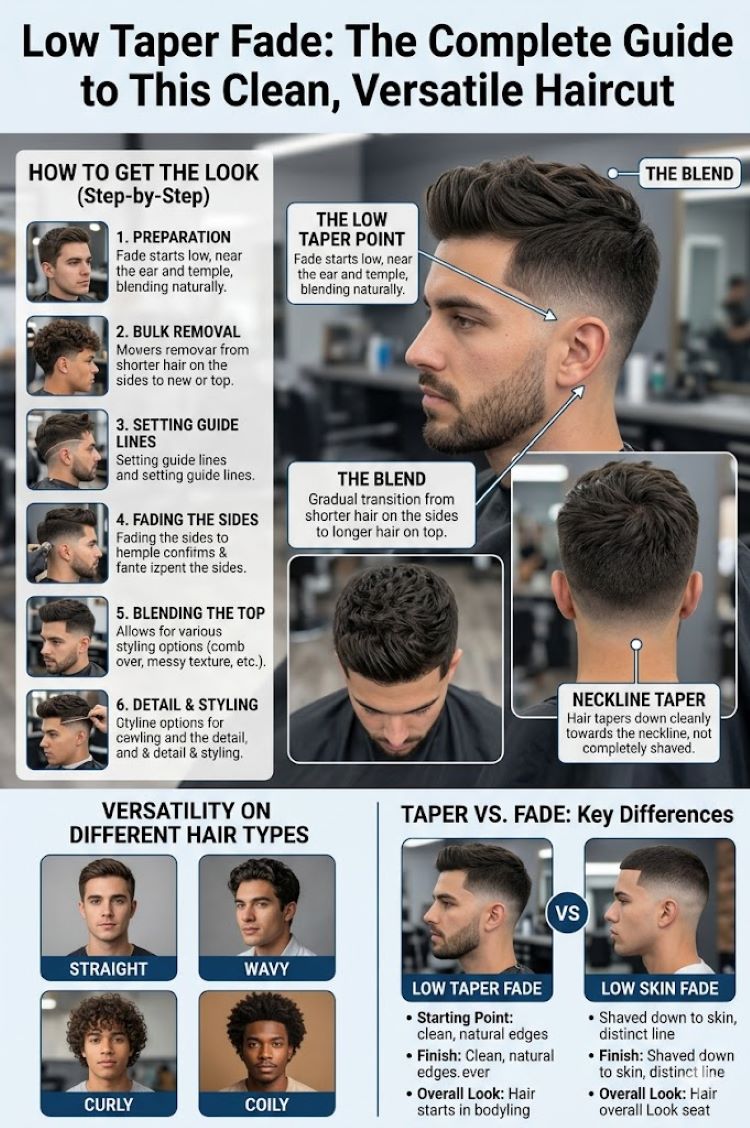
The low taper fade is one of the most versatile and popular men’s haircuts of the past decade. If you’ve spent time at any modern barbershop, you’ve seen this cut on countless clients. But what exactly is a low taper fade, and what makes it different from other similar cuts?
Understanding what is a low taper fade starts with understanding the two components: the taper and the fade. This haircut combines gradual length reduction (the taper) with a blended fade that sits lower on the sides and back of the head. This combination creates a clean, modern look that works for professional settings and casual styles alike.
This guide covers everything you need to know about getting and maintaining this classic cut, including variations for different hair types.
What Is a Low Taper Fade?
A low taper fade haircut is a men’s cut that features a gradual transition from longer hair on top to shorter hair on the sides and back. The key word here is “low,” which specifies where the fade begins.
In this style, the shorter length starts approximately one to two inches above the ear. The hair gradually gets shorter as it moves down toward the neck, but the transition happens lower on the head compared to other fade styles. This creates a stronger look on top while maintaining clean lines on the sides.
What defines this cut fundamentally? It’s about balance. You’re maintaining enough length on top for styling and texture while keeping the sides clean and tapered. The blend between lengths is smooth and gradual, which is the hallmark of quality work.
The fade aspect refers to how the barber blends the different lengths together. Rather than a hard line, a proper fade creates a seamless transition using progressively shorter clipper guards or scissor techniques.
Understanding the Components: Taper vs. Fade
Many people use “taper” and “fade” interchangeably, but they have distinct meanings in barbering.
A taper is a gradual reduction in hair length. When you get a taper haircut, the barber cuts progressively shorter lengths as they move toward your neck. The transition can be gradual or more pronounced depending on your preference. A low taper means this transition happens lower on the head, typically around ear level.
A fade is a specific type of taper that blends lengths so smoothly they appear to fade into skin. In a fade haircut, the barber uses multiple clipper guard sizes to create an almost invisible transition. The result looks polished and blended rather than stepped.
When someone asks about a taper fade haircut, they’re asking for both: a gradual transition (the taper) that’s smoothly blended (the fade). A low taper fade specifically applies these techniques with the transition starting lower.
Low Taper Fade vs. Other Fade Styles
Understanding how a low taper fade differs from similar cuts helps you communicate with your barber and choose the right style.
High Taper Fade: In a high taper fade, the transition begins higher, typically near the temples. This creates a more dramatic difference between top and sides. By contrast, this style keeps more hair on the sides, creating a less extreme look.
Drop Fade: A drop fade curves the fade line around the back of the ears, creating a distinctive curved transition. This haircut uses a more traditional straight line instead.
Low Fade: A low fade is broader than a low taper fade. While it features gradual tapering on the sides, a low fade might refer to the overall short length on the sides and back without necessarily emphasizing the tapering aspect.
Low Skin Fade: In a low skin fade, the sides and back are cut so short they show the scalp. This style maintains more length and never shows skin.
Getting Your First Low Taper Fade
When you visit your barber, asking for this cut should be clear enough, but additional details help.
Tell your barber:
- “I want a low taper fade” (this establishes the basic cut)
- Where you want the fade to start (typically one to two inches above the ear)
- How short you want the sides (this varies from person to person; some prefer a 0.5 guard, others prefer 1 or 1.5)
- How long you want the top (most styles keep one to three inches on top, depending on desired texture and styling options)
Bring photos if you have a specific style in mind. Your barber can see exactly what you’re envisioning rather than relying on description alone.
The first cut is important because it sets the baseline. A good barber will ask questions about your hair type, how much time you want to spend styling, and your overall aesthetic preferences. These conversations shape the final result.
Low Taper Fade for Different Hair Types
The low taper fade works across different hair types, but execution varies slightly.
Low Taper Fade Straight Hair
For straight hair, this style creates clean, sharp lines. The taper is easy to see because straight hair naturally falls in predictable directions. The blend from longer to shorter is obvious and looks polished.
With straight hair, this cut benefits from being cut slightly longer on top, giving you styling flexibility. Straight hair holds its shape without much product, so you can achieve multiple looks with the same cut.
The low taper fade straight hair style works well with pomade, wax, or no product at all. Many men with straight hair prefer this look for its low-maintenance appeal.
Low Taper Fade Curly Hair
For curly hair, this style works beautifully but requires different cutting technique. Curly hair shrinks when it dries, so a barber cuts curly hair longer than it will appear dry.
Low taper fade curly hair benefits from extra length on top to accommodate the curl shrinkage. What looks like three inches when wet becomes closer to one and a half inches when dry. A good barber understands this and cuts accordingly.
The fade on curly hair is slightly less visible than on straight hair because the curl texture disguises length variations. However, the sides still look clean and shaped.
Styling curly hair with this cut requires more product. You’ll typically use a curl cream or gel to define and control the curls. This style is currently popular in men’s grooming because it combines professionalism with texture.
Low Taper Fade with Textured Fringe
This variation adds modern flair. The fringe (longer hair in the front) combines with the tapered sides and back. This style works for men who want some length and styling potential while maintaining clean sides.
The fringe can be styled up, back, or to the side depending on your preference. It works well for creative professionals and anyone wanting a slightly edgier look.
Low Taper Fringe Variations
A low taper fringe specifically emphasizes the front longer hair. Some men prefer this version that blends with the taper, while others want more contrast between front and sides.
Maintenance and Upkeep
This haircut isn’t maintenance-free, but it’s relatively manageable.
You’ll need a trim every three to four weeks to maintain the fade as your hair grows. Hair growth is continuous, so the tapered blend gradually becomes less sharp over time. Regular trims keep the style crisp.
Between cuts, you can maintain your look at home with clippers if you have experience. Many men go this route to save money, while others prefer visiting their barber every month.
For the top, styling products depend on your preference. Pomade, wax, clay, and cream all work with this cut. Experiment to find what gives you the look you want.
Daily styling is simple. With straight hair, you might just comb it back or to the side. With curly hair, use a curl cream to enhance texture. Many men appreciate this style because it looks good with minimal effort.
Styling Options for Your Low Taper Fade Haircut
This cut offers multiple styling directions.
Slicked Back: Apply pomade or gel and comb the hair straight back. This creates a classic, polished look suitable for formal occasions.
Side Swept: Push the hair to the side and slightly back. This is a versatile style that works for work and casual settings.
Textured and Tousled: Use a matte product like clay or paste to create texture. This modern style emphasizes the natural movement of your hair.
Curly and Defined: For curly hair, a curl-specific product enhances natural texture. This style celebrates your hair’s natural curl pattern.
No Product: Many men style their low taper fade with no product at all, letting the cut do the work.
Who Should Get a Low Taper Fade
A low taper fade works for most men, but certain factors influence whether it’s ideal for you.
Hair Type: Works best with hair that’s naturally straight to wavy. Very coily or kinky hair can get a low taper fade, but the barber needs special technique experience.
Face Shape: The low taper fade works for most face shapes. The longer top can be styled to balance your face, and the clean sides suit everyone.
Professional Settings: The low taper fade is professional enough for corporate environments. It looks clean and maintained without being trendy to the point of distraction.
Styling Time: If you want minimal styling time, a low taper fade works. If you want more options, keep slightly more length on top.
Personal Style: The low taper fade suits men who appreciate modern, clean aesthetics. If you prefer longer hair or more dramatic styles, other cuts might be better.
Common Mistakes to Avoid
When getting a low taper fade, avoid these common issues:
Not Being Specific About Length: Saying “just fade it” without specifying where the fade starts and how short leaves your barber guessing. Be specific about where you want the transition.
Waiting Too Long Between Cuts: A low taper fade looks best with fresh cuts every three to four weeks. Letting it grow longer than six weeks loses the crisp line.
Choosing the Wrong Barber: Not all barbers are skilled at fades. Ask for recommendations or look at portfolios before sitting in the chair.
Not Showing Photos: If you have a specific style in mind, show your barber. Communication prevents disappointment.
Expecting No Maintenance: A low taper fade requires regular trims. If you want a truly low-maintenance cut, ask your barber for a different style.
Key Takeaways
- What is a low taper fade is a men’s haircut featuring a gradual transition from longer hair on top to shorter sides, with the fade starting lower on the head.
- A taper fade haircut combines the taper (gradual length reduction) and the fade (smooth blending between lengths).
- This style differs from high taper fade by starting the transition lower on the head, maintaining more hair on the sides.
- This cut for straight hair creates sharp, clean lines and works well with pomade or no product.
- Curly hair versions require cutting longer than the finished length because curls shrink when dry.
- This style with textured fringe adds front length while maintaining tapered sides, perfect for versatile styling.
- This haircut requires trims every three to four weeks to maintain the crisp blend as hair grows.
- Drop fade and low skin fade are alternatives, with drop fade creating a curved line and low skin fade showing scalp.
- The fringe variation emphasizes longer front hair while keeping sides clean and tapered.
- This style works with multiple styling options including slicked back, side-swept, textured, and natural curly looks.
- Most face shapes and professional settings suit this cut, making it one of the most versatile men’s styles available.
- Communication with your barber about exact length, fade placement, and desired style prevents disappointment and ensures quality results.