The legal age to get a tattoo is not a single universal number in the United States. It varies by state, and the rules around parental consent complicate things further for anyone under 18. If you are searching for how old do you have to be to get a tattoo, the answer depends on where you live and whether a parent or guardian is involved. This guide breaks down the requirements clearly.
The General Rule: 18 Without Parental Consent
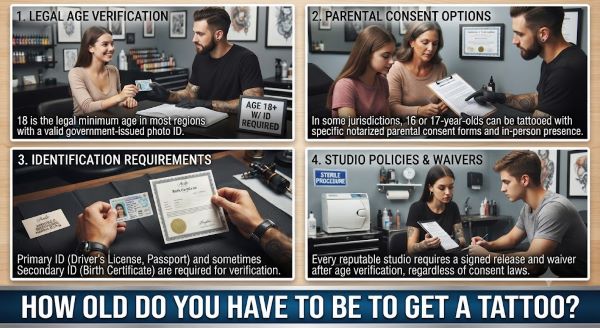
The most straightforward answer to how old do you have to be to get a tattoo is 18 in most states, if you are getting a tattoo without parental involvement. At 18, you are a legal adult and can consent to tattooing on your own in every US state.
This is the standard most reputable tattoo studios operate by regardless of what local law technically permits, since many studios have internal policies that set 18 as their minimum age for new clients even in states where younger clients with parental consent are legally allowed.
States That Allow Tattooing Minors With Parental Consent
Many states allow tattooing of minors who are 16 or 17 with documented parental or guardian consent. A smaller number of states permit tattooing of minors at any age below 18 with parental consent, though this is less common and often comes with additional requirements.
The parental consent rules vary significantly in their specifics. In some states, a parent simply needs to sign a consent form at the studio. In others, the parent must be physically present during the tattoo session, not just providing a signed document in advance. Some states also require notarized consent forms, adding a documentation layer beyond a simple signature.
Examples of states with parental consent provisions (these can change, so always verify with your state’s laws):
- Texas allows tattooing of minors with parental consent when the parent is present during the procedure.
- Florida allows tattooing of minors 16 and older with written, notarized parental consent.
- California prohibits tattooing anyone under 18 regardless of parental consent, making it one of the stricter states.
- New York prohibits tattooing anyone under 18 regardless of parental consent.
- Georgia allows tattooing of minors with parental consent when the parent is present.
Because state laws change and individual county or city regulations sometimes add layers on top of state law, checking your specific state’s current statute rather than relying on a general list is always the right approach.
States That Prohibit Tattooing Minors Entirely
Several states have no provision for tattooing minors under any circumstances, including with parental consent. In these states, the answer to how old do you have to be to get a tattoo is simply 18, full stop, regardless of any parental involvement.
California and New York are among the most well-known examples of this category, but other states also fall into this group. A tattoo artist in these states who tattoos a minor, even with parental consent, can face criminal charges, loss of their license, and business penalties.
Why Reputable Studios Often Set 18 as Their Personal Minimum
Even in states where tattooing minors with parental consent is technically legal, many established tattoo studios choose to set 18 as their internal minimum age regardless. The reasons are practical and professional.
Legal liability is a primary concern. If a minor later disputes the tattoo or if questions arise about whether consent was properly obtained, the studio carries more risk than they would with an adult client who consented entirely on their own. Studios also cite the permanence of tattoos as a factor, preferring that clients be at an age where their decision is more likely to be a considered, adult choice rather than something made during a developmental period where preferences and identity can change significantly.
This is not a policy you can typically negotiate around at reputable shops. A studio that maintains an 18-and-over policy as a matter of professional practice will apply it consistently, and any shop that easily makes exceptions to this policy is often a signal of looser professional standards overall.
What Parental Consent Typically Requires in Practice
If you are in a state that allows tattooing of minors with parental consent, the actual documentation and process typically involves several steps beyond just a parent saying yes.
Most studios require a government-issued ID from both the minor and the consenting parent or guardian, to verify ages and the legal guardianship relationship. A signed consent form specific to the tattoo studio, often notarized in states that require it, is standard. In many cases the parent must be physically present during the entire tattoo session, not just at the point of signing paperwork.
If only one parent is listed on a birth certificate or custody documents are relevant to who can legally consent, some studios ask for documentation clarifying that the consenting parent has legal authority to provide that consent.
Medical and Tattoo Healing Considerations for Young People
Beyond the legal question of how old do you have to be to get a tattoo, some dermatologists and tattoo professionals raise considerations about tattooing very young skin. Younger skin is more prone to certain healing responses, and there is a consideration that skin continues developing into early adulthood, which can sometimes affect how a tattoo settles and ages over time.
This is not a reason to avoid tattooing legal clients of any age, but it is worth factoring into the decision alongside the legal requirements, particularly for anyone getting their first tattoo at a younger age.
International Considerations
For context outside the United States, age requirements for tattooing vary significantly by country as well. In the United Kingdom, tattooing anyone under 18 is prohibited regardless of consent, similar to California and New York’s approach. Australia generally prohibits tattooing under 18 without parental consent, with some variation by state or territory. In Canada, requirements vary by province.
If you are traveling and considering getting tattooed abroad, checking the local laws of your specific destination is essential, since assuming a country has more permissive rules than your home region can lead to unpleasant surprises.
How to Check Your State’s Current Tattoo Age Laws
Because state laws can and do change, and because county or city ordinances sometimes differ from state law, the most reliable way to confirm the current legal requirements in your area is to check your state’s actual legislative code or contact your state’s Department of Health, which typically regulates body art practices.
Calling tattoo studios in your area directly is also a practical approach. A reputable shop will know the current local rules and will be able to tell you their specific policies and what documentation they require from minor clients in states where it is permitted.
Key Takeaways
- How old do you have to be to get a tattoo depends on your state, but the standard answer in most places is 18 without parental consent, which applies universally across all US states.
- Many states allow tattooing of minors who are 16 or 17 with documented parental consent, though the specific requirements vary, including whether a parent must be physically present and whether notarized forms are required.
- Some states, including California and New York, prohibit tattooing anyone under 18 entirely, regardless of parental consent.
- Even in states where tattooing minors is legally permitted with consent, many reputable studios maintain their own 18-and-over policy as a matter of professional practice and liability management.
- Parental consent in states that allow it typically requires government-issued ID from both parties, a signed consent form, and often a physical parental presence during the procedure itself.
- How old do you have to be to get a tattoo internationally also varies by country, with the UK, for example, prohibiting tattooing under 18 without exception regardless of consent.
- State laws change, so checking your state’s current statutes or contacting a local studio directly is more reliable than relying on general lists that may reflect outdated information.
- Studios that easily make exceptions to their posted age policies are often a signal of looser professional standards overall, and finding a shop with a consistent, clear policy is generally a better sign of professional quality.